View in other NatureServe Network Field Guides
NatureServe
Montana
Utah
Wyoming
Idaho
Wisconsin
British Columbia
South Carolina
Yukon
California
New York
Sedge Darner - Aeshna juncea
State Rank Reason (see State Rank above)
The Sedge Darner is currently ranked S3S5 as a "potential species of concern" in Montana because it is potentially at risk of extirpation in the state, due to limited and/or declining numbers, range and/or habitat, even though it may be abundant in some areas.
General Description
The Sedge Darner is a a fairly uncommonly occurring member of the family Aeshnidae in Montana, and a potential species of concern. Darners are among the largest and fastest-flying North American dragonflies. This is a pale species, bluish areas being ampler than in most other Aeschnas. Face greenish blue, more or less overspread with brownish except on sides of the frons and facial lobes of postclypeus. Black crossbands on fronto-clypeal suture and on both front and rear margins of labrum. Black T spot above has an ill-defined front margin; its stalk is widened to its confluence with black of vertex. Top of vertical tubercle broadly yellow, occiput obscurely so. All pale stripes of thorax broad and all carinae narrowly black. Two stripes on front broadly widened laterally under crest. Between the two on each side, a short intervening half stripe terminates wide at top and tapers to a point halfway down toward spiracle. Legs brown, paler basally. Wings dull hyaline, with tawny costa and stigma. Cells in fork of radial sector and on both radial and median planates rather more numerous and irregular than is usual in Aeschna. Abdomen brown, broadly marked with blue; black on all carinae and on joinings of middle segments. Two swollen basal segments have a middorsal yellow line; sides of 2 streaked with brown and yellow, and all yellow below auricle in male. Each auricle armed with four minute teeth. Segment 3 moderately constricted. Darkening segments beyond 3 have usual spots larger than in other species, postero-dorsal one increasing markedly to rearward, covering most of depressed dorsum of 10. Mid-dorsal tubercle of 10 low and erect. The nymphs of Aeschna are among the most graceful of odonate nymphs, streamlined of body and neatly patterned in markings of green and brown that tend to run in longitudinal bands when among the green stems of water plants, in camouflage. The head is a little flattened. The legs are slender and pale, usually ornamented with rings of brown or of lighter and darker greens. The abdomen is widest in the middle and tapers gracefully to its slender tip (Needham and Westfall, 1955).
Species Range
Montana Range
Range Descriptions
 Native
Range Comments
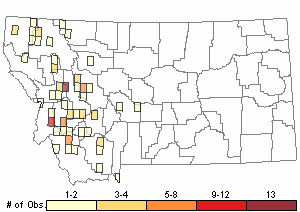
Sedge Darners are widespread across Alaska; Labrador; Canada: Alberta, British Columbia, Manitoba, Newfoundland, North West Territories, Ontario, Quebec, Yukon; United States: Colorado, New Hampshire, Wyoming south to Colorade and New Mexico; also from boreo-alpine regions of Europe and Asia (Needham and Westfall, 1955). Sedge Darners are usually encountered at higher latitudes or at higher elevations at lower latitudes. They are often the most commonly encountered darner species in the extreme north. Sedge Darners are circumboreal in their distribution, occurring in Europe, Eurasia, and Japan (Dunkle 2000, Paulson 2009). In Montana, found in the western Middle Rockies forested region of the state.
Observations in Montana Natural Heritage Program Database
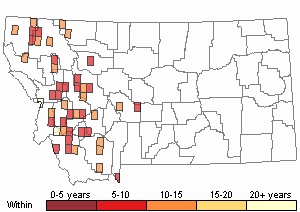
Number of Observations: 116
(Click on the following maps and charts to see full sized version)
Relative Density
Recency

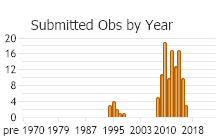
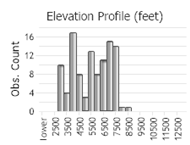 (Observations spanning multiple months or years are excluded from time charts)
Habitat
Sedge Darners occupy ponds, lakes, pools, bays, and marshes with extensive sedge vegetation, as well as mossy fens, semipermanent ponds, ditches with emergent vegetation, and quiet stream portions in forested areas (Dunkle 2000, Paulson 2009). This species is known to hunt on and around tree trunks late into evening (Dunkle 2000).
Ecological Communities Associated with this Species
Wetland and Riparian
Alkaline - Saline Wetlands
Alpine Riparian and Wetland
Peatland
Wet Meadow and Marsh
Food Habits
Larvae feed on a wide variety of aquatic insects, such as mosquito larvae, other aquatic fly larvae, mayfly larvae, and freshwater shrimp. They will also eat very small fish and tadpoles.
Adult- The dragonfly will eat almost any soft-bodied flying insect including mosquitoes, flies, small moths, mayflies, and flying ants or termites.
Reproductive Characteristics
Male Sedge Darners are territorial and patrol, with extensive hovering, a small area of sedge along the shorelines of breeding sites. Females tend to oviposit either at the waterline or just beneath the waterline into emergent sedges and grasses, matted roots or moss (Dunkle 2000, Paulson 2009).
Stewardship Responsibility
References
- Literature Cited AboveLegend:
 View Online Publication
 Needham, J.G. and M.J. Westfall, Jr. 1954. A manual of the dragonflies of North America (Anisoptera). University of California Press, Berkeley. 615 pp.
- Additional ReferencesLegend: View Online Publication
Do you know of a citation we're missing?- Dunkle, S.W. 2000. Dragonflies through binoculars: A field guide to dragonflies of North America. New York, NY. Oxford University Press. 266 pp.
- Nelson, Howard E. 1953. The summer dragonflies of Flathead Valley, Montana. M.A. Thesis. University of Montana. Missoula, MT.
- Paulson, D.R. 2009. Dragonflies and Damselflies of the West. Princeton University Press, Princeton. 535 pp.
- Web Search Engines for Articles on "Sedge Darner"
- Additional Sources of Information Related to "Insects"