View in other NatureServe Network Field Guides
NatureServe
Montana
Utah
Wyoming
Idaho
Wisconsin
British Columbia
South Carolina
Yukon
California
New York
Milbert's Tortoiseshell - Aglais milberti
General Description
[From Ferris and Brown 1981; Scott 1986; Opler and Wright 1999; Glassberg 2001; Pyle 2002] Forewing 2.0-2.8 cm. Tip of forewing squared-off; upperside dark with a wide orange submarginal band grading inward to yellow, forewing cells with two orange to red-orange bars; a narrow black marginal border on both wings upper surface, the hindwing border may contain blue spots; undersurface dark striated brown with paler submarginal band.
Shropshire and Tallamy (2025) provide a list, with synonymies, of 13,055 described native, exotic, and occasional straying Lepidoptera species of North America, north of Mexico; known but undescribed taxa, taxa with unresolved taxonomy, and excluded species are also included. The
main manuscript includes links to supplementary materials, including a reference list for Lepidoptera of North America north of Mexico, and a filterable spreadsheet with information on taxonomy, synonymy, size ranges of species, distribution by state, province, and country with references, and host-plant Family and Genus associations with references.
Phenology
One flight in the far north and higher elevations, mostly late July overwintering to June; two flights at lower elevation and in the east, late June to early August and late August overwintering to May (Scott 1986). Mid January to early October in Oregon and Washington with peaks in April to June and July to August (Pyle 2002);
Diagnostic Characteristics
Best determined by a combination of the outer margins irregular with a short tail-like hindwing projection, uppersurface outer third orange grading inward to yellow-orange, a narrow black marginal border on hindwing sometimes including blue spots; undersurface of wings with a pale submarginal band.
Species Range
Montana Range
Range Descriptions
 Native
Range Comments
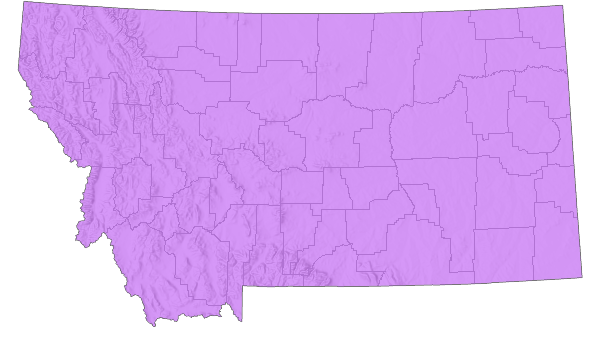
Boreal North America, from southern Alaska east to Newfoundland and West Virginia, south in the west to California, Nevada, Arizona, and New Mexico; migrants in the east infrequently appear south to Arkansas and Georgia (Scott 1986; Opler and Wright 1999; Glassberg 2001; Pyle 2002); to at least 3990 m elevation in California (Garth and Tilden 1963), 4206 m elevation in Colorado (Scott and Scott 1978). In Montana, reported throughout the state (Kohler 1980; Stanford and Opler 1993). Mainly rare to uncommon, but common in the Pacific Northwest (Glassberg 2001).
Shropshire and Tallamy (2025) provide a link to a supplemental filterable spreadsheet with information on distribution by state, province, and country with references for all Lepidoptera species of North America, north of Mexico.
Observations in Montana Natural Heritage Program Database
Number of Observations: 383
(Click on the following maps and charts to see full sized version)
Map Help and Descriptions
Relative Density

Recency
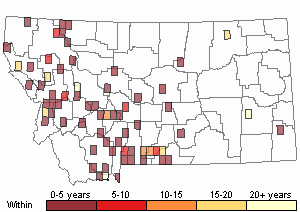
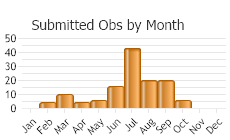
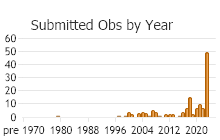
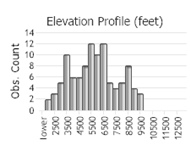 (Observations spanning multiple months or years are excluded from time charts)
Migration
Semi-migratory; appears to make seasonal elevational movements in the western US mountains, flying upslope in summer, downslope in autumn (Shapiro 1974, 1979; Scott 1986, 1992; James and Nunnallee 2011). In areas of alpine karst, this species may overwinter in caves (Taylor et al. 2009).
Habitat
Montane wet meadows, moist streamsides, riparian areas, open woodlands, parks, gardens, above treeline in alpine habitats (Ferris and Brown 1981; Opler and Wright 1999; Glassberg 2001; Pyle 2002). In Glacier National Park, Montana reported from mesic montane meadows and above treeline in alpine habitat (Debinski 1993).
Shropshire and Tallamy (2025) provide a link to a supplemental filterable spreadsheet with information on host-plant Family and Genus associations with references for all Lepidoptera species of North America, north of Mexico.
National Vegetation Classification System Groups Associated with this Species
Grassland
Montane - Subalpine Grassland
Wetland and Riparian
Alkaline - Saline Wetlands
Peatland
Riparian and Wetland Forest
Riparian Shrubland
Wet Meadow and Marsh
Human Land Use
Agriculture
Food Habits
Larval food plants include Urtica in particular (several species), rarely Helianthus, Laportea, Ribes, Salix (Ferris and Brown 1981; Scott 1986, 1992, 2006; Pyle 2002). Adults feed on flower nectar (including Achillea, Allium, Anaphalis, Apocynum, Arctostaphylos, Arnica, Barbarea, Ceanothus, Chrysothamnus, Cirsium, Crypthantha, Erigeron, Erioganum, Erysimum, Helianthella, Heterotheca, Jamesia, Medicago, Monarda, Monardella, Phlox, Prunus, Salix, Sedum, Senecio, Solidago, Taraxacum), sap, fermetted fruit, and mud (Ferris and Brown 1981; Scott 1986, 2014; Pyle 2002; James and Nunnallee 2011).
Reproductive Characteristics
Females lay eggs in clusters (as many as 713) on the undersides of host plant leaves. Eggs hatch in about 5-7 days (depending on temperature), with pupation occurring 21 days after egg-hatch; 4, 3, 4, 3, and 7 days spent in L1-L5 instars, respectively (depending on temperature). L5 instars pupate away from host plant, adults eclose (emerge) from pupae in 7 days. Larvae gregarious when young, live in a silk nest atop host plant. Older larvae (L4-L5) usually solitary, may live in rolled-up leaves tied with silk; L5 may leave nests and feed openly. Overwinter (hibernate) as pupae or adults (Ferris and Brown 1981; Scott 1986, 1992, 2006; Guppy and Shepard 2001; James and Nunnallee 2011). Spring males perch behind shrubs and on logs mostly in the afternoon and usually on rocky places below hilltops, sometimes on banks where no hilltops are present, to await passing females; hill-topping behavior not noted in autumn (overwintering) males (Scott 1975b, 1982, 1986).
Stewardship Responsibility
References
- Literature Cited AboveLegend:
 View Online Publication
 Debinski, D. 1993. Butterflies of Glacier National Park, Montana. Occasional Papers of the Museum of Natural History, the University of Kansas, Lawrence, Kansas. No. 159: 1-13.
- Ferris, C.D. and F.M. Brown (eds). 1981. Butterflies of the Rocky Mountains. Univ. of Oklahoma Press. Norman. 442 pp.
- Garth, J.S. and J.W. Tilden. 1963. Yosemite butterflies: an ecological survey of the butterflies of the Yosemite sector of the Sierra Nevada, California. Journal of Research on the Lepidoptera 2: 1-96.
- Glassberg, J. 2001. Butterflies through Binoculars: A Field Guide to the Butterflies of Western North America. Oxford University Press.
- Guppy, C.S. and J.H. Shepard. 2001. Butterflies of British Columbia: including western Alberta, southern Yukon, the Alaska Panhandle, Washington, northern Oregon, northern Idaho, northwestern Montana. UBC Press (Vancouver, BC) and Royal British Columbia Museum (Victoria, BC). 414 pp.
- Kohler, S. 1980. Checklist of Montana Butterflies (Rhopalocera). Journal of the Lepidopterists' Society 34(1): 1-19.
- Opler, P.A. and A.B. Wright. 1999. A field guide to western butterflies. Second edition. Peterson Field Guides. Houghton Mifflin Company, Boston, Massachusetts. 540 pp.
- Opler, P.A., K. Lotts, and T. Naberhaus, coordinators. 2010. Butterflies and moths of North America. Big Sky Institute, Bozeman, MT. Available at: www.butterfliesandmoths.org (Accessed 15 June 2015).
- Pyle, R.M. 2002. The butterflies of Cascadia: a field guide to all the species of Washington, Oregon, and surrounding territories. Seattle Audubon Society, Seattle, Washington. 420 pp.
- Scott, J.A. 1975b. Mate-locating behavior of western North American butterflies. Journal of Research on the Lepidoptera 14:1-40.
- Scott, J.A. 1982. Mate-locating behavior of western North American butterflies. II. New observations and morphological adaptations. Journal of Research on the Lepidoptera 21(3): 177-187.
- Scott, J.A. 1986. The butterflies of North America: a natural history and field guide. Stanford University Press, Stanford, California.
- Scott, J.A. 1992. Hostplant records for butterflies and skippers (mostly from Colorado) 1959-1992, with new life histories and notes on oviposition, immatures, and ecology. Papilio new series #6. 185 p.
- Scott, J.A. 2006. Butterfly hostplant records, 1992-2005, with a treatise on the evolution of Erynnis, and a note on new terminology for mate-locating behavior. Papilio new series #14. 74 p.
- Scott, J.A. 2014. Lepidoptera of North America 13. Flower visitation by Colorado butterflies (40,615 records) with a review of the literature on pollination of Colorado plants and butterfly attraction (Lepidoptera: Hersperioidea and Papilionoidea). Contributions of the C.P. Gillette Museum of Arthopod Diversity. Fort Collins, CO: Colorado State University. 190 p.
- Scott, J.A. and G.R. Scott. 1978. Ecology and distribution of the butterflies of southern central Colorado. Journal of Research on the Lepidoptera 17(2): 73-128.
- Shapiro, A.M. 1974. Altitudinal migration of central California butterflies. Journal of Research on the Lepidoptera 13(3): 157-161.
- Shapiro, A.M. 1979. Nymphalis milberti (Nymphalidae) near sea level in California. Journal of the Lepidopterists' Society 33(3): 200-201.
- Stanford, R.E. and P.A. Opler. 1993. Atlas of western USA butterflies: including adjacent parts of Canada and Mexico. Unpubl. Report. Denver and Fort Collins, Colorado 275 pp.
- Additional ReferencesLegend: View Online Publication
Do you know of a citation we're missing?- Allen, T.J., J.P. Brock, and J. Glassberg. 2005. Caterpillars in the field and garden: a field guide to the butterfly caterpillars of North America. Oxford University Press.
- Brock, J.P. and K. Kaufman. 2003. Kaufman Field Guide to Butterflies of North America. Houghton Mifflin Company, New York, NY 284 pp.
- Caruthers, J.C., and D. Debinski. 2006. Montane meadow butterfly species distributions in the Greater Yellowstone Ecosystem. University of Wyoming National Park Service Research Center Annual Report, 2006. Vol. 30, Art. 14. 85-96.
- Fultz, J.E. 2005. Effects of shelterwood management on flower-visiting insects and their floral resources. M.Sc. Thesis. Bozeman, MT: Montana State University. 163 p.
- Maxell, B.A. 2016. Northern Goshawk surveys on the Beartooth, Ashland, and Sioux Districts of the Custer-Gallatin National Forest: 2012-2014. Montana Natural Heritage Program. Helena, MT. 114pp.
- Sater, S. 2022. The insects of Sevenmile Creek, a pictorial guide to their diversity and ecology. Undergraduate Thesis. Helena, MT: Carroll College. 242 p.
- Shropshire, K.J. and D.W. Tallamy. 2025. Lepidoptera of North America, north of Mexico: an annotated list containing geographic ranges and host-plant records. Zookeys.1261:101-113.
- Taylor, S.J., J.K. Krejca, M.E. Slay, and T.L. Harrison. 2009. Milbert's Tortoiseshell, Aglais milberti (Lepidoptera: Nymphalidae): A facultative trogloxene in alpine caves.Speleobiology Notes. 1:20-23.
- Threatful, D.L. 1988. A list of the butterflies and skippers of Mount Revelstoke and Glacier National Parks, British Columbia, Canada (Lepidoptera). Journal of Research on the Lepidoptera 27(3-4): 213-221.
- Web Search Engines for Articles on "Milbert's Tortoiseshell"
- Additional Sources of Information Related to "Insects"