View in other NatureServe Network Field Guides
NatureServe
Montana
Utah
Wyoming
Idaho
Wisconsin
British Columbia
South Carolina
Yukon
California
New York
Marten - Martes americana
Other Names:
American Marten, Pacific Marten,
Martes caurina
Native Species
Global Rank:
G5
State Rank:
S4
(see State Rank Reason below)
Agency Status
USFWS:
USFS:
BLM:
State Rank Reason (see State Rank above)
Marten are found in montane forests in western and portions of central Montana. Populations appear relatively stable. The species faces threats from fire, timber harvest, and changes in snow depth and structure due to increasing average temperatures.
General Description
This house cat-sized animal is distinctly weasel-like in appearance. Has short legs, prominent ears, pointed face, and a well-furred tail constituting one-third of its total length. Stiff glossy guard hairs with dense silky under-fur. The soft, dense, yellowish-brown fur shades to dark brown on its bushy tail and legs. Pale buff to orange patch on throat and breast. Has ability to rotate hind limbs to enable descending trees headfirst. Total length: 21 to 26 inches. Weight: 1.5 to 2.75 pounds (Foresman 2012).
Recent genetic data indicate that there are two species of Marten within Montana with a zone of hybridization that still needs to be mapped to inform conservation status designations and management efforts; Pacific Marten (Martes caurina) has more of a southern distribution and American Marten (Martes americana) has more of a northern distribution in western Montana (Dawson and Cook 2012, Dawson et al. 2017).
Diagnostic Characteristics
Mink has white patch on chin. Fisher is larger, dark brown with grizzled head and back. Red Fox has white tip on tail.
Species Range
Montana Range
Range Descriptions
 Native
Observations in Montana Natural Heritage Program Database
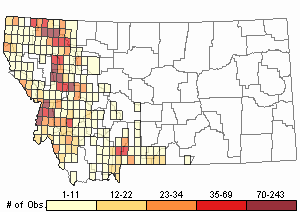
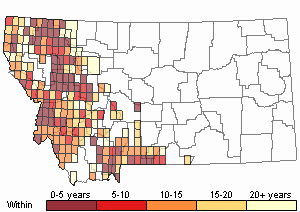
Number of Observations: 4214
(Click on the following maps and charts to see full sized version)
Relative Density
Recency
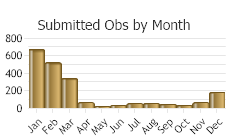
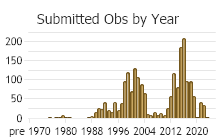
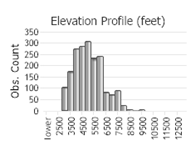 (Observations spanning multiple months or years are excluded from time charts)
Migration
Non-migratory.
Habitat
Primarily a boreal animal preferring mature conifer or mixed wood forests. Severe forest disturbance can significantly reduce habitat value. Uses deadfall and snags as den sites. In Glacier National Park, most often located in mesic spruce and subalpine fir types. Stands averaged 35% canopy cover. Martens often traveled along forest cover/open area ecotones. Maternity dens in rock outcrops, tree cavities (O'Neill 1980, Burnett 1981).
National Vegetation Classification System Groups Associated with this Species
Alpine
Alpine - Sparse and Barren
Alpine - Vegetated
Forest and Woodland
Deciduous Forest and Woodland
Low Elevation - Xeric Forest and Woodland
Montane - Subalpine Forest and Woodland
Shrubland
Foothills - Montane Shrubland
Grassland
Montane - Subalpine Grassland
Wetland and Riparian
Alpine Riparian and Wetland
Peatland
Riparian and Wetland Forest
Riparian Shrubland
Wet Meadow and Marsh
Recently Disturbed or Modified
Harvested Forest
Insect-Killed Forest
Recently Burned
Human Land Use
Developed
Food Habits
Eats a variety of animal and plant materials associated with the mature forest. Is an opportunistic feeder that primarily feeds on a variety of small mammals. Meadow Voles and Red-backed Voles were staples in Glacier National Park. Also used Cricetidae, jumping mice, shrews, and ground squirrels. Use of birds, insects, and fruit variable by season. Will use snowshoe hares (O'Neill 1980).
Ecology
Populations fluctuate in response to prey availability, juvenile dispersal, and mortality of adult females. Average home range for adult male = 2.9 sq km, female = 0.7 sq km, resident juveniles = 0.7 sq km (Burnett 1981).
Reproductive Characteristics
Mates during summer with young born during April. Exhibits delayed implantation and an eight- to nine-month gestation. Average litter size is two to four. Breeds in July and August. Implantation occured February 22 and April 10. Parturition 25 to 28 days after implantation. Delayed implantation period of 8 months. Gestation of 9 months.
Management
Prior to 1953, two extant species of Marten were recognized within North America, the American Marten (M. americana) and Pacific Marten (M. caurina). However, Wright (1953) analyzed morphometric differences between these species and concluded that these should be considered subspecies of M. americana, and a single species of marten was recognized until 2014. In 2014 the "Revised Checklist of North American Mammals North of Mexico, 2014" (Bradley et al. 2014) elevated the status of the Pacific Marten from subspecies of American Marten to species based on recent research on marten genetics (Dawson and Cook 2012). Within Montana hybridization between Pacific and American Martens has been documented (Wright 1953, Dawson and Cook 2012, Dawson et al. 2017), although the geographic region where hybridization occurs, or its impacts on fitness and other population parameters are currently unknown.
Stewardship Responsibility
References
- Literature Cited AboveLegend:
 View Online Publication
- Bradley, R.D., L.K. Ammerman, R.J. Baker, L.C. Bradley, J.A. Cook, R.C. Dowler, C. Jones, D.J. Schmidly, F.B. Stangl, R.A. Van Den Bussche, and B. Wursig. 2014. Revised Checklist of North American Mammals North of Mexico, 2014.
- Burnett, G.W. 1981. Movements and habitat use of American Marten in Glacier National Park, Montana. M.S. Thesis. University of Montana. Missoula. 130 pp.
 Dawson, N. and J. Cook. 2012. Behind the Genes. pp. 23-38 In Keith B. Aubry, William J. Zielinski, Martin G. Raphael, Gilbert Proulx, Steven W. Buskirk (eds). Diversification of North American Martens (Martes americana and M. caurina ): A New Synthesis. Cornell University Press. Ithaca, NY. 577 p.
- Dawson, N., J. Colella, M. Small, K. Stone, S. Talbot, and J. Cook. 2017. Historical biogeography sets the foundation for contemporary conservation of martens (genus Martes) in northwestern North America. Journal of Mammalogy. 98(3):715-730.
- Foresman, K.R. 2012. Mammals of Montana. Second edition. Mountain Press Publishing, Missoula, Montana. 429 pp.
- O'Neil, T.A. 1980. Pine marten maternal den observations. The Murrelet 61(3):102-103.
- Wright, P.L. 1953. Intergradation between Martes americana and Martes caurina in western Montana. Journal of Mammalogy 34:74-86.
- Additional ReferencesLegend: View Online Publication
Do you know of a citation we're missing?- Adelman, E.B. 1979. A survey of the nongame mammals in the Upper Rattlesnake Creek drainage of western Montana. M.S. thesis. University of Montana, Missoula. 129 pp.
- Banci, V. 1994. Wolverine. Pp. 99-127. IN: Ruggiero, L. F., K. B. Aubry, S. W. Buskirk, L. J. Lyon, amd W. J. Zielinski (eds.), The scientific basis for conserving forest carnivores, American marten, fisher, lynx, and wolverine in the western United States. U.S.D.A, Forest Serv. Rocky Mountain Forest and Range Exper. Stat. Gen. Tech. Report RM-254. 184 pp.
- Bennett, L.A. 1984. Marten ecology and habitat management in the Central Rocky Mountains. Colorado Coop Wildlife Res. Unit.
- Berg, W. E. 1982. Reintroduction of fisher, pine marten, and river otter. Pages 159-173 in G. C. Sanderson, editor. Midwest furbearer management. Proc. Symp. 43rd Midwest Fishand Widlife Conference, Wichita, Kansas.
- Burnett, G. W. 1980. Ecological study of American pine marten. Pp. 43-44 in K. L. McArthur ed., 1979 Annual Research Summary, Unpubl. Rep., USDI National Park Service, Glacier National Park, MT. 54 pp.
- Buskirk, S. W. 1992. Conserving circumboreal forests for martens and fishers. Cons. Biol. 6:318-320.
- Buskirk, S.W., S.C. Forrest, and M.G. Raphael. 1989. Winter resting site ecology of marten in the central Rocky Mountains. J. Wildl. Manage. 53: 191-196.
- Chapman, J.A., and G.A. Feldhamer. 1982. Wild mammals of North America: biology, management, and economics. Johns Hopkins University Press, Baltimore, Maryland.
- Clark, T.W., E. Anderson, C. Douglas, and M. Strickland. 1987. Martes americana. Mammalian Species 289:1-8.
- Clark, T.W., T.M. Campbell, III, and T.N. Hauptman. 1989. Demographic characteristics of American marten populations in Jackson Hole, Wyoming. Great Basin Nat. 49:587-596.
- Coffin, K. 1992. The distribution of marten prey species in southwest Montana. P. 67 in G. L. Dusek, comp., Proc. Montana Chap., The Wildl. Soc., Whitefish.
- Coffin, K.W. 1994. Population characteristics and winter habitat selection by pine marten in southwest Montana. M.Sc. Thesis. Bozeman, MT: Montana State University. 94 p.
- Conard, Benjamin R. 2000. Status and management of forest carnivores on the Beaverhead-Deerlodge National Forest. M.S. Thesis. University of Montana. Missoula, MT.
- Cross, James, and Richard P. Weckwerth, 1977, Upland Game Bird (and Fur Survey) Inventory. Wildlife Investigations, Region One. W-130-R-8, Job No. II-1, July 1, 1976 - June 30, 1977.
- Cross, James, and Richard P. Weckwerth, 1978, Upland Game Bird (and Fur Survey) Inventory. Wildlife Investigations, Region One. W-130-R-9, Job No. II-1, July 1, 1977 - June 30, 1978.
- Cross, James, and Richard P. Weckwerth, 1982, Upland Game Bird (and Fur Survey) Inventory. Wildlife Investigations, Region One. W-130-R-13, Job No. II-1, July 1, 1981 - June 30, 1982.
- Cross, James, and Richard P. Weckwerth, 1983, Upland Game Bird (and Fur Survey) Inventory. Wildlife Investigations, Region One. W-130-R-14, Job No. II-1, July 1, 1982 - June 30, 1983.
- Deems, E.F., Jr. and D. Pursley (eds). 1978. North American furbearers: their management, research and harvest status in 1976. Int. Assoc. Fish and Wildlife Agencies and University of Maryland. 171 p.
- Fager, C. 1991. Harvest dynamics for marten in southwest Montana. In K. Aune, comp., Proc. Montana Chap., The Wildl. Soc., Bozeman.
- Fager, C.W. 1991. Harvest dynamics and winter habitat use of the pine marten in southwest Montana. M.Sc. Thesis. Bozeman, MT: Montana State University. 73 p.
- Flathead National Forest. U.S. Forest Service., 1993, Wildlife landscape evaluation, Swan Valley. Draft Report.
- Foresman, K.R. 2001. The wild mammals of Montana. American Society of Mammalogists, Special Publication Number 12. Lawrence, KS. 278 pp.
- Frisina, M., K. AU, K. Aune and H. Hash. 1991. Montana's pine marten management program. Pine Marten Symposium, University of Wyoming, Laramie. (Abstract)
- Greer, K. R. 1955. Mink age and sex ratios. Montana Fish and Game Dept. P-R Quarterly Rep. April-June: 148-170.
- Hagmeier, E. M. 1956. Distribution of marten and fisher in North America. Can. Field-Nat. 70:149-168.
- Hawley, V. D. 1959. Marten ecology. Montana Fish and Game Dept. P-R Compl. Rep., Proj. W-49-R-7:68-73.
- Hawley, V. D. 1960. Marten population studies. Montana Fish and Game Department P-R Job Compl. Rep. Proj. W-49-R-8:43-55.
- Hawley, V. D. and F. S. Newby. 1957. Marten home ranges and population fluctuctions. J. Mammal. 38(2):174-184.
- Hawley, V.D. 1955. The ecology of the marten in Glacier National Park. M.S. thesis. University of Montana, Missoula. 131 pp.
- Hawley, Vernon D. 1959. Marten Population Studies, Project No. W-49-R-8, Job No. II-G.
- Hoffmann, R.S. and D.L. Pattie. 1968. A guide to Montana mammals: identification, habitat, distribution, and abundance. Missoula, MT: University of Montana. 133 p.
- Ivan, Jacob S. 2000. Effectiveness of covered track plats for detecting American Marten. M.S. Thesis. University of Montana. Missoula, MT.
- Jonkel, C. J. 1963. Sexual maturity and implantation of blastocysts in the wild pine marten. Journal of Wildlife Management 27(1):93-98.
- Jonkel, C.J. 1959. An ecological and physiological study of Pine Marten. M.S. Thesis. Montana State Univ., Missoula. 81 pp.
- Joslin, Gayle, and Heidi B. Youmans. 1999. Effects of recreation on Rocky Mountain wildlife: a review for Montana. [Montana]: Montana Chapter of the Wildlife Society.
- Koehler, G.M. and M.G. Hornocker. 1977. Fire effects on marten habitat in the Selway-Bitterroot Wilderness. J. Wildl. Manage. 41(3):500-505.
- Koehler, G.M., J.A. Blakesley, and T.W. Koehler. 1990. Marten use of successional forest stages during winter in north-central Washington. NW.Nat. 71:1-4.
- Kujala, Q. 1992. Habitat selection by radio-collared marten in southwest Montana. P. 66 in G. L. Dusek, comp., Proc. Montana Chap., The Wildl. Soc., Whitefish.
- Kujala, Q.J. 1993. Winter habitat selection and population status of pine marten in southwest Montana. M.Sc. Thesis. Bozeman, MT: Montana State University. 58 p.
- Kujala, Quentin J., 1993, Winter habitat selection and population status of pine marten in southwest Montana. W-100-R-4-6, V, FB-1, Sub-project no. 1, 2, Job no. 3. Statewide Wildlife Program. Furbearers and Predators. Furbearers. Management Surveys and iIvestigations, Research and Technical Services. Pine marten populations and habitat relationships in southwest Montana. June 16, 1993.
- Maj, M., and E. O. Garten. 1994. Fisher, lynx, wolverine: Summary of distribution information. Pp. 169-175. IN: Ruggiero, L. F., K. B. Aubry, S. W. Buskirk, L. J. Lyon, amd W. J. Zielinski (eds.), The scientific basis for conserving forest carnivores, American marten, fisher, lynx, and wolverine in the western United States. U.S.D.A, Forest Serv. Rocky Mountain Forest and Range Exper. Stat. Gen. Tech. Report RM-254. 184 pp.
- Marshall, W. H. 1946. Winter food habits of the pine marten in Montana. J. Mammal. 27:83-84.
- Montana Dept. of Fish, Wildlife & Parks, 1985, Upland Game Bird and Furbearer Survey and Inventory. Wildlife Investigations, Region One. W-130-R-16, Job No. II-1, July 1, 1984 - June 30, 1985.
- Montana Dept. of Fish, Wildlife & Parks, 1986, Upland Game Bird and Furbearer Survey and Inventory. Wildlife Investigations, Region One. W-130-R-17, Job No. II-1, July 1, 1985 - June 30, 1986.
- Montana Dept. of Fish, Wildlife & Parks, 1987, Upland Game Bird and Furbearer Survey and Inventory. Wildlife Investigations, Region One. W-130-R-18, Job No. II-1, July 1, 1986 - June 30, 1987.
- Newby, F. E. 1952. Marten in Montana. Montana Wildl. Autumn.
- Newby, F. E. 1955. Marten ecology. Montana Fish and Game Dept. P-R Job Compl. Rep. Proj. W-49-R-4, VI(l and 2).
- Newby, F. E. 1958. Marten population status. Montana Fish and Game Dept. P-R Job Compl. Rep. Proj. W-49-R-7:56-67.
- Newby, F. E., and V. D. Hawley. 1954. Progress on a marten live-trapping study. Trans. N. Am. Wildl. Conf. 19:452-462.
- Newby, F. E., R. Weckwerth and V. Hawley. 1956. Marten ecology. Montana Fish and Game Dept. P-R Job Compl. Rep. Proj. W-49R- 5, Job II-I.
- Newby, Fletcher E. 1957. Marten Population Status, Project No. W-49-R-6, Job No. II-G.
- Newby, Fletcher E. and Hawley, Vernon D. 1956. Marten Population Status, Project No. W-49-R-5, Job No. II-G.
- Oechsli, L.M. 2000. Ex-urban development in the Rocky Mountain West: consequences for native vegetation, wildlife diversity, and land-use planning in Big Sky, Montana. M.Sc. Thesis. Montana State University, Bozeman. 73 p.
- Pattie, D.L. and N.A. M. Verbeek. 1967. Alpine mammals of the Beartooth Plateau. Northwest Science 41(3): 110-117.
- Peterson, Joel, and Michael R. Frisina, 1985, II Upland Game Bird Survey and Inventory, Region Three, Game Birds and Fur (Small Game) Survey and Inventory. Statewide Wildlife Survey and Inventory. W-130-R-16, Job No. II-3, July 1, 1984 - June 30, 1985.
- Peterson, Joel, and Michael R. Frisina, 1986, II Upland Game Bird Survey and Inventory, Region Three, Game Birds and Fur (Small Game) Survey and Inventory. Statewide Wildlife Survey and Inventory. W-130-R-17, Job No. II-3, July 1, 1985 - June 30, 1986.
- Peterson, Joel, and Michael R. Frisina, 1987, II Upland Game Bird and Inventory, Region Three, Game Birds and Fur (Small Game) Survey and Inventory. Statewide Wildlife Survey and Inventory. W-130-R-18, Job No. II-3, July 1, 1986 - June 30, 1987.
- Raine, R.M. 1983. Winter habitat use and responses to snow cover of fisher (Martes pennanti) and marten (Martes americana) in southeastern Manitoba. Can. J. Zool. 61:25-34.
- Raine, R.M. 1987. Winter food habits and foraging behavior of fishers (Martes pennanti) and martens (Martes americana) in southeastern Manitoba. Can. J. Zool. 65: 745-747.
- Reid, F. 2006. Peterson Field Guide to Mammals of North America, 4th Edition. Houghton Mifflin Company: Boston and New York, 608 pp.
- Rocky Mountain Front Ranger District. 1992. Rare furbearer and mountain lion observations along the Rocky Mountain Front: 1989-1992. USDA, Lewis & Clark Natl. For., Annual Report. 27 pp.
- Ruggiero, L.F., K.B. Aubry, S.W. Buskirk, L.J. Lyon, and W.J. Zielinski. 1994. The scientific basis for conserving forest carnivores: American marten, fisher, lynx, and wolverine in the western United States. Fort Collins, CO: General Technical Report RM-254. U.S. Department of Agriculture, Forest Service, Rocky Mountain Forest and Range Experiment Station. 184 p.
- Rust, H. J. 1946. Mammals of northern Idaho. J. Mammal. 27(4): 308-327.
- Spencer, W. D. 1987. Seasonal rest-site preferences of pine martens in the northern Sierra Nevada. J. Wildl. Manage. 51:616-621.
- Spencer, W. D., and W. J. Zielinski. 1983. Predatory behavior of pine martens. J. Mammal. 64:715-717.
- Spencer,W.D., R.H. Barrett, and W.J. Zielinski. 1983. Marten habitat preferences in the northern Sierra Nevada. The Journal of Wildlife Management. 47(4): 1181-1186.
- Stearns-Roger Inc., 1975, Environmental baseline information of the Mount Vernon Region, Montana. January 31, 1975.
- Steventon, J. D. and J. T. Major. 1982. Marten use of habitat in a commercially clear-cut forest. J. Wildl. Manage. 46(1):175-182.
- Thier, T. J. 1990. Population characteristics and the effects of hunting on Black Bears in a portion of northwestern Montana. M.S. thesis. University of Montana, Missoula. 100 pp.
- Thompson, I. D., I. J. Davidson, S. O'Donnell and F. Brazeau. 1989. Use of track transects to measure the relative occurrence of some boreal mammals in uncut forest and regeneration stands. Can. J. Zool. 67:1816-1823.
- Thompson, Richard W., Western Resource Dev. Corp., Boulder, CO., 1996, Wildlife baseline report for the Montana [Montanore] Project, Lincoln and Sanders counties, Montana. In Application for a Hard Rock Operating Permit and Proposed Plan of Operation, Montanore Project, Lincoln and Sanders Counties, Montana. Vol. 5. Stroiazzo, John. Noranda Minerals Corp., Libby, MT. Revised September 1996.
- Thompson, W.K. 1949. A study of marten in Montana. Proc. West. Assoc. State Game and Fish Comm. 29:181-188.
- TVX Mineral Hill Mine, Amerikanuak, Inc., Gardiner, MT., 2002, Yearly summary of wildlife observation reports. 1990-2002 Letter reports.
- Tweten, R.G. 1984. Baseline survey of furbearing mammals within the South Fork drainage Sun River, Montana. M.Sc. Thesis. Bozeman, MT: Montana State University. 63 p.
- Vinkey, R.S. 2003. An evaluation of fisher (Martes pennanti) introductions in Montana. M.S. Thesis. University of Montana. Missoula, MT. 97 pp.
- Weckwerth, R. P. and V. D. Hawley. 1962. Marten food habits and population fluctuations in Montana. J. Wildl. Manage. 26(1): 55-74.
- Weckwerth, R.P. 1957. The relationship between the marten population and the abundance of small mammals in Glacier National Park. M.S. thesis. University of Montana, Missoula. 76 pp.
- Zielinski, W.J. and T.E. Kucera. 1995. American marten, fisher, lynx, and wolverine: survey methods for their detection. Berkeley, CA: USDA Forest Service Pacific SW Research Station, Gen. Tech. Rep. PSW-GTR-157. 163 p.
- Zielinski, W.J., W.D. Spencer, and R.H. Barrett. 1983. Relationship between food habits and activity patterns of pine martens. J. Mammal. 64:387-396.
- Web Search Engines for Articles on "Marten"
- Additional Sources of Information Related to "Mammals"