View in other NatureServe Network Field Guides
NatureServe
Montana
Utah
Wyoming
Idaho
Wisconsin
British Columbia
South Carolina
Yukon
California
New York
Ord's Kangaroo Rat - Dipodomys ordii
Native Species
Global Rank:
G5
State Rank:
S5
(see State Rank Reason below)
Agency Status
USFWS:
USFS:
BLM:
State Rank Reason (see State Rank above)
Species is uncommon across eastern Montana. It's presence is largely restricted by soil type and it readily uses disturbed habitats. It faces no known threats.
General Description
The Ord's Kangaroo Rat measures about 10 1/2 inches head to tail, with the tail comprising half or more of that length. It weighs about 2 1/2 ounces. In Montana, it is a dark cinnamon buff on top and pure white below (Foresman 2012). It has white patches above its eyes and at the base of its ears, and the extremely large hind feet are white with five toes (Zeveloff and Collett 1988). The tail appears to have four stripes, two dark top and bottom stripes, and two white side stripes. The lower stripe tapers to the end of the tufted tail. Like the jumping mice, the Ord's Kangaroo Rat has fur-lined cheek pockets for storing food, which open on each side of its mouth. At night its eyes appear to glow with a faded amber light. It has 20 teeth, the upper incisors having grooved faces. The lower incisors are rounded (Burt and Grossenheider 1964). Able to hear a rattlesnake coiling or an owl flying, the Ord's Kangaroo Rat uses fast, ricocheting jumps ruddered by its long tail to escape danger (Kritzman 1977).
Species Range
Montana Range
Range Descriptions
 Native
Western Hemisphere Range
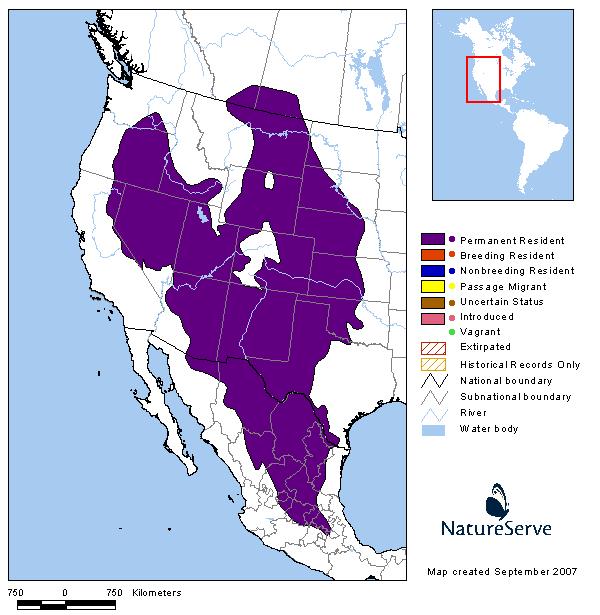
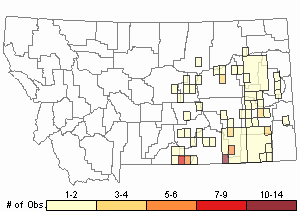
Observations in Montana Natural Heritage Program Database
Number of Observations: 110
(Click on the following maps and charts to see full sized version)
Relative Density
Recency
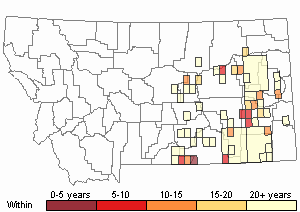

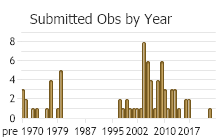
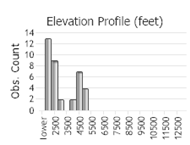 (Observations spanning multiple months or years are excluded from time charts)
Migration
Non-migratory.
Habitat
Sandy areas along dry streams and on flats. Sage-grassland areas.
Ecological Communities Associated with this Species
Forest and Woodland
Low Elevation - Xeric Forest and Woodland
Montane - Subalpine Forest and Woodland
Shrubland
Arid - Saline Shrubland
Sagebrush Shrubland
Grassland
Lowland - Prairie Grassland
Sparse and Barren
Sparse and Barren
Wetland and Riparian
Riparian and Wetland Forest
Riparian Shrubland
Food Habits
Granivorous - seeds of weeds, grasses, forbs. Insects in summer.
Ecology
Transports food in cheek pouches. Removes contents by applying pressure from shoulder against pouch. Plugs burrow door during day.
Reproductive Characteristics
Difficult to predict breeding season for Montana. In northeast Colorado, breeds February to August. Two to four young/litter. Possibly similar in MT. Two or more litters/season.
Stewardship Responsibility
References
- Literature Cited AboveLegend:
 View Online Publication
 Burt, W.H. and R.P. Grossenheider. 1964. A field guide to the mammals. Houghton Mifflin Co.
- Foresman, K.R. 2012. Mammals of Montana. Second edition. Mountain Press Publishing, Missoula, Montana. 429 pp.
- Kritzman, E.B. 1977. Little mammals of the Pacific Northwest. Pacific Search Press, Seattle, WA.
- Zeveloff, S.I. and F.R. Collett. 1988. Mammals of the Intermountain west. University of Utah Press, Salt Lake City, Utah.
- Additional ReferencesLegend: View Online Publication
Do you know of a citation we're missing?- [PRESI] Powder River Eagle Studies Incorporated. 1998b. Spring Creek Mine 1997 wildlife monitoring studies. Powder River Eagle Studies Incorporated. Gillete, WY.
- Buck, C.L. 1939. Pattern correlation of mammalian teeth as a means of identification. M.Sc. Thesis. Bozeman, Montana: Montana State University. 55 p.
- Dood, A.R. 1980. Terry Badlands nongame survey and inventory final report. Montana Department of Fish, Wildlife, and Parks and Bureau of Land Management, Helena, MT. 70 pp.
- Foresman, K.R. 2001. The wild mammals of Montana. American Society of Mammalogists, Special Publication Number 12. Lawrence, KS. 278 pp.
- Garrison, T.E. and T.L. Best. 1990. Dipodomys ordii. Mammalian Species 353:1-10.
- Hanauska-Brown, L., B.A. Maxell, A. Petersen, and S. Story. 2014. Diversity Monitoring in Montana 2008-2010 Final Report. Montana Fish, Wildlife & Parks. Helena, MT. 78 pp.
- Hoffmann, R.S. and D.L. Pattie. 1968. A guide to Montana mammals: identification, habitat, distribution, and abundance. Missoula, MT: University of Montana. 133 p.
- Hurd, H. D., 1956, Plan for Meeting of the Montana Soil and Water Conservation Needs Committee
- Joslin, Gayle, and Heidi B. Youmans. 1999. Effects of recreation on Rocky Mountain wildlife: a review for Montana. [Montana]: Montana Chapter of the Wildlife Society.
- Langford, A. 1983. Pattern of nocturnal activity of male Dipodomys ordii (Heteromyidae). Southwestern Naturalist 28:341-346.
- Martin, P.R., K. Dubois and H.B. Youmans. 1981. Terrestrial wildlife inventory in selected coal areas, Powder River resources area final report. Montana Department of Fish, Wildlife and Parks and Bureau of Land Management, Helena, MT. No. YA-553-CTO- 24. 288 p.
- Powder River Eagle Studies, Inc., Gillette, WY., 1999, Spring Creek Mine 1998 Wildlife Monitoring. March 1999.
- Reid, F. 2006. Peterson Field Guide to Mammals of North America, 4th Edition. Houghton Mifflin Company: Boston and New York, 608 pp.
- Scow, K.L. 1981. Ecological distribution of small mammals at Sarpy Creek, Montana, with special consideration of the Deer Mouse, Peromyscus maniculatus. M.Sc. Thesis. Bozeman, Montana: Montana State University. 73 p.
- Web Search Engines for Articles on "Ord's Kangaroo Rat"
- Additional Sources of Information Related to "Mammals"