View in other NatureServe Network Field Guides
NatureServe
Montana
Utah
Wyoming
Idaho
Wisconsin
British Columbia
South Carolina
Yukon
California
New York
Northern Short-tailed Shrew - Blarina brevicauda
State Rank Reason (see State Rank above)
Species has one capture record in Montana and data to assess status are unavailable.
General Description
The Northern Short-tailed Shrew is realtively large and robust, with inconspicuous ears and minute eyes. The snout is pointed and somewhat proboscis-like but relatively shorter and thicker than in other shrews. The tail is relatively short (< 20% of total length), hairy, and faintly to distinctly bicolored. Dorsal pelage is slaty gray, darker in winter than summer (Jones et al. 1983, Van Zyll de Jong 1983, George et al. 1986). Large adult size and relatively short tail distinguishes this species of shrew from any other in Montana.
Diagnostic Characteristics
A relatively large and robust shrew (total length usually > 110 mm, occipito-premaxillary length usually > 21.5 mm) with a relatively short tail (20% of total length). Dental formula as in shrews of the genus Sorex, with 32 total teeth (including 5 unicuspids in each upper jaw).
Species Range
Montana Range
Range Descriptions
 Native
Western Hemisphere Range
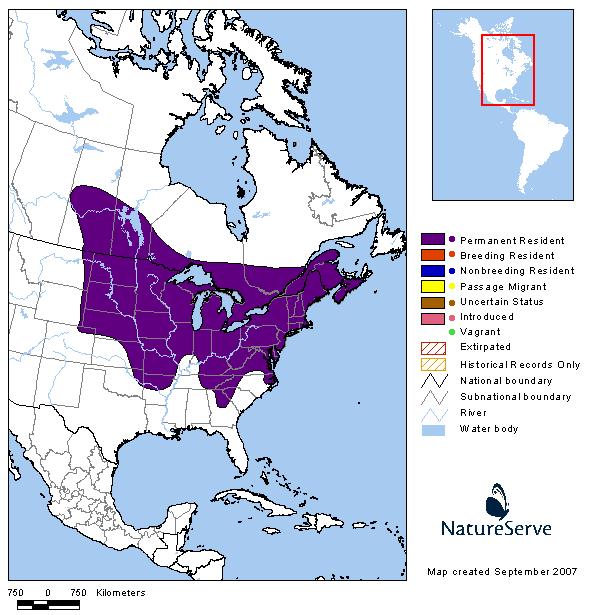
Range Comments
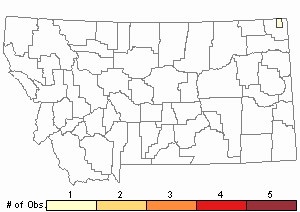
Species is among the least observed of any taxa in the state. Limited information from the single observation near Johnson Lake and collections at the Fort Union National Historic Site along the Missouri River in North Dakota near Snowden, Montana, suggest that the species is present in the far northeastern region of Montana.
Observations in Montana Natural Heritage Program Database
Number of Observations: 1
(Click on the following maps and charts to see full sized version)
Relative Density
Recency
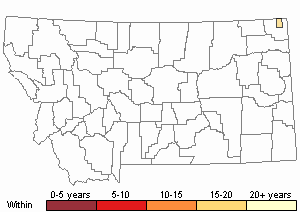


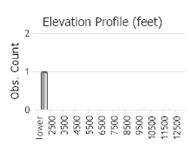 (Observations spanning multiple months or years are excluded from time charts)
Migration
The species is considered non-migratory, although information on movements is lacking for Montana.
Habitat
Considered hypothetical in extreme northeastern Montana since at least 1968 (Hoffmann and Pattie 1968) until two were captured in August 2005 in Sheridan County in marshy, prairie pothole habitat about 1.35 miles (2.2 km) south of the Saskatchewan border. Farther east, within the main range of the species, Northern Short-tailed Shrews are most common in hardwood forests with deep leaf litter and in brushy sites adjacent to ponds and streams, less common in conifer forest and grassland. In Manitoba, this shrew is reported to be most common in grass-sedge marsh and willow-alder shrubs (Jones et al. 1983, Van Zyll de Jong 1983, George et al. 1986).
National Vegetation Classification System Groups Associated with this Species
Grassland
Lowland - Prairie Grassland
Wetland and Riparian
Alkaline - Saline Wetlands
Peatland
Riparian and Wetland Forest
Riparian Shrubland
Wet Meadow and Marsh
Food Habits
Food habits have not been studied in Montana. Elsewhere, the diet includes a variety of invertebrates, including insects (esp. Lepidoptera, Diptera and Coleoptera larvae), millipedes, annelids (earthworms), mollusks (snails and slugs) and terrestrial amphipods (sowbugs). Vertebrates are less important than invertebrates, but during winter may capture small mammals such as voles (Microtus spp.) and smaller shrews (Sorex spp.). Sometimes food is hoarded. Infrequently attacks much larger animals (e.g. gartersnakes). The saliva is poisonous (even to humans) and aids in capture of prey; may vocalize when feeding (Jones at al. 1983, Van Zyll de Jong 1983, George et al. 1986).
Ecology
Little ecological information is available for the Northern Short-tailed Shrew in Montana. Elsewhere, the species is active throughout the year, both on the surface and in tunnel systems (its own and those of other small mammals). It is active day and night for short periods, but may be inactive up to 80% of the day, by drastically lowering its resting metabolic rate. Nests are built underground, and may be lined with vegetation or animal fur from voles. Two distinct age classes are evident in summer and autumn, representing adults born the previous year and young of the current breeding seasons. Densities can range from 1.6/ha to 121/ha, with home-ranges averaging about 2.5 ha. Winter mortality in some populatons may reach 90%. Raptorial birds and snakes appear to be the main predators of Northern Short-tailed Shrews, as they seem to be distasteful to most mammalian predators (Jones et al. 1983, Van Zyll de Jong 1983, George et al. 1986).
Reproductive Characteristics
No information from Montana. Throughout the range, breeding may occur any month, usually during February to October but greatly reduced during summer. Gestation is 21-22 days, average litter sizes range from 4 to 10, weaning occurs by 25 days of age, adult size (but not weight) is reached by about 50 days, females are reproductively receptive when about 50 days of age, males at about the same age (65 days the earliest successful reproduction reported). Adults may live up to 33 months (Jones et al. 1983, George et al. 1986).
Management
No management needs have been identified and no measures have been enacted to promote Northern Short-tailed Shrew conservation in Montana. Wetland drainage or alteration, and loss of riparian vegetation (e.g. aspen, birch, willow, cottonwood) in woody draws and around springs or seeps, has the potential to negatively impact local populations. Additional surveys for Northern Short-tailed Shrew can provide the basis for development of conservation protocols by determining its full distribution in Montana, the array of habitats in which it occurs, its relative abundance in different habitats, and, if properly designed, an idea of how different habitat disturbances affect this shrew at the margin of its global range.
Stewardship Responsibility
References
- Literature Cited AboveLegend:
 View Online Publication
- George, S. B., J. R. Choate and H. H. Genoways. 1986. Blarina brevicauda. American Society of Mammalogists, Lawrence, KS. Mammalian Species Number 261:1-8.
 Hoffmann, R.S. and D.L. Pattie. 1968. A guide to Montana mammals: identification, habitat, distribution, and abundance. Missoula, MT: University of Montana. 133 p.
- Jones, J.K., D.M. Armstrong, R.S. Hoffmann and C. Jones. 1983. Mammals of the northern Great Plains. University of Nebraska Press, Lincoln. 379 pp.
- Van Zyll de Jong, C.G. 1983. Handbook of Canadian mammals. 1. Marsupials and insectivores. National Museum of Natural Sciences, National Museums of Canada, Ottawa, Canada. 210 pp.
- Additional ReferencesLegend: View Online Publication
Do you know of a citation we're missing?- Foresman, K.R. 2001. The wild mammals of Montana. American Society of Mammalogists, Special Publication Number 12. Lawrence, KS. 278 pp.
- Foresman, K.R. 2012. Mammals of Montana. Second edition. Mountain Press Publishing, Missoula, Montana. 429 pp.
- Joslin, Gayle, and Heidi B. Youmans. 1999. Effects of recreation on Rocky Mountain wildlife: a review for Montana. [Montana]: Montana Chapter of the Wildlife Society.
- Reid, F. 2006. Peterson Field Guide to Mammals of North America, 4th Edition. Houghton Mifflin Company: Boston and New York, 608 pp.
- Woodman, N. 2018. American recent Eulipotyphla Nesophontids, Solenodons, Moles, and Shrews in the New World. Smithsonian Contributions to Zoology 650. 108 p.
- Web Search Engines for Articles on "Northern Short-tailed Shrew"
- Additional Sources of Information Related to "Mammals"