View in other NatureServe Network Field Guides
NatureServe
Montana
Utah
Wyoming
Idaho
Wisconsin
British Columbia
South Carolina
Yukon
California
New York
Masked Shrew - Sorex cinereus
Native Species
Global Rank:
G5
State Rank:
S5
(see State Rank Reason below)
Agency Status
USFWS:
USFS:
BLM:
State Rank Reason (see State Rank above)
Species is relatively common within suitable habitat and widely distributed across portions of the state
General Description
A medium-sized shrew (adults usually 9 to 11 cm total length, tail 35 to 45 mm, 3 to 6 g) with a sharply pointed snout, beady eyes, and small ears nearly hidden in the fine soft pelage; dorsal pelage varies from dark brown to gray, depending on the season and location. Five small unicuspidate teeth behind the upper incisors: the fifth is minute, the fourth generally is smaller than the third (the fourth is less commonly equal to, or sometimes larger than the third in subspecies ohioensis) and both of these are smaller than the first and second; tips of teeth are dark chestnut; feet are delicate, with slender weak claws; condylobasal length of skull 14.6 to 16.9 mm; maxillary breadth less than 4.6 mm; posterior border of infraorbital foramen even with, or anterior to, plane of space between M1 and M2 (Godin 1977, Hall 1981, Armstrong 1987).
Diagnostic Characteristics
Generally paler and smaller than S. fumeus (95 to 129 mm total length) (Godin 1977). See Hall (1981) for a key to North American species of Sorex. See (Carraway 1995) for a key to western North American soricids based primarily on dentaries.
Species Range
Montana Range
Range Descriptions
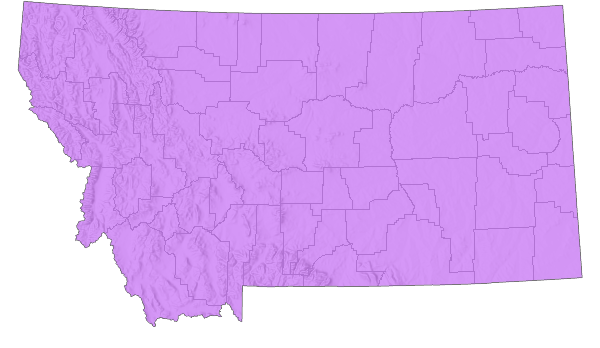
 Native
Western Hemisphere Range
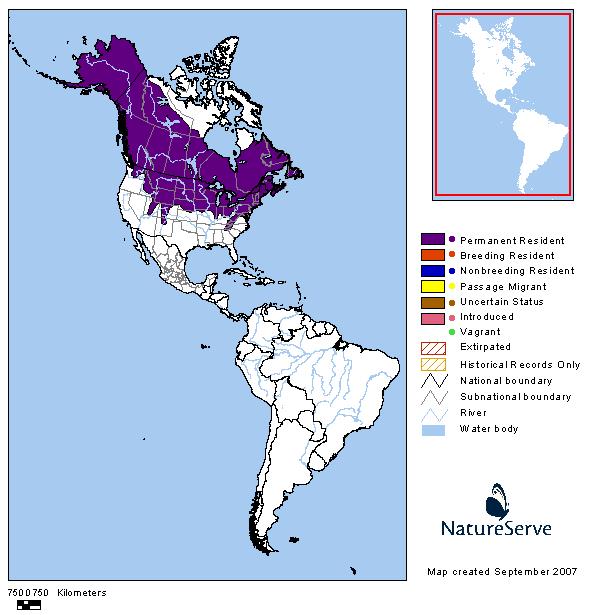
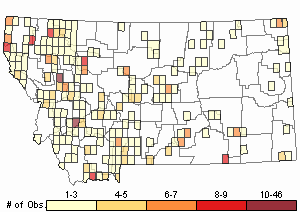
Observations in Montana Natural Heritage Program Database
Number of Observations: 520
(Click on the following maps and charts to see full sized version)
Map Help and Descriptions
Relative Density
Recency
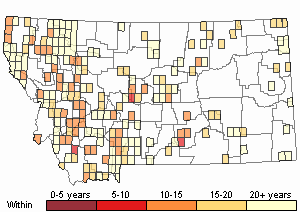
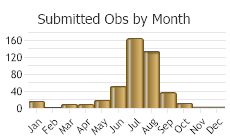
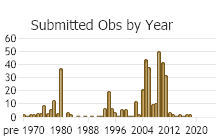
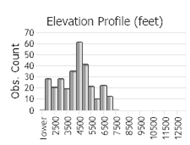 (Observations spanning multiple months or years are excluded from time charts)
Migration
Non-migratory.
Habitat
Coniferous forest (Junge and Hoffmann 1981). In western Montana, where Sorex vagrans also occurs, S. cinereus is usually restricted to drier coniferous forest habitat (Hoffmann and Pattie 1968).
National Vegetation Classification System Groups Associated with this Species
Alpine
Alpine - Sparse and Barren
Forest and Woodland
Deciduous Forest and Woodland
Low Elevation - Xeric Forest and Woodland
Montane - Subalpine Forest and Woodland
Shrubland
Foothills - Montane Shrubland
Sagebrush Shrubland
Grassland
Lowland - Prairie Grassland
Montane - Subalpine Grassland
Wetland and Riparian
Alkaline - Saline Wetlands
Alpine Riparian and Wetland
Peatland
Riparian and Wetland Forest
Riparian Shrubland
Wet Meadow and Marsh
Recently Disturbed or Modified
Harvested Forest
Insect-Killed Forest
Introduced Vegetation
Recently Burned
Human Land Use
Agriculture
Developed
Food Habits
Invertebrates, salamanders, small mice. In winter, seeds may be main item in diet (van Zyll de Jong 1983).
Ecology
Populations fluctuate year to year. Birds, snakes, and mammalian carnivores are predators (van Zyll de Jong 1983).
Reproductive Characteristics
Probably polyestrous. Spring (April) to autumn, altricial young born in a spherical nest of dry vegetation (van Zyll de Jong 1983).
Stewardship Responsibility
References
- Literature Cited AboveLegend:
 View Online Publication
- Armstrong, D.M. 1987. Rocky Mountain mammals. Revised edition. Colorado Associated Univ. Press, Boulder. x + 223 pp.
 Carraway, L.N. 1995. A key to recent Soricidae of the western United States and Canada based primarily on dentaries. Occasional Papers of the Natural History Museum, University of Kansas (175):1-49.
- Hall, E.R. 1981. The mammals of North America, volumes I and II. John Wiley & Sons, New York, NY. 1181 pp.
- Hoffmann, R.S. and D.L. Pattie. 1968. A guide to Montana mammals: identification, habitat, distribution, and abundance. Missoula, MT: University of Montana. 133 p.
- Junge, J.A. and R.S. Hoffmann. 1981. An annotated key to the long-tailed shrews (genus Sorex) of the United States and Canada, with notes on middle American Sorex. Occasional Papers of the Museum of Natural History, the University of Kansas 94: 1-48.
- Van Zyll de Jong, C.G. 1983. Handbook of Canadian mammals. 1. Marsupials and insectivores. National Museum of Natural Sciences, National Museums of Canada, Ottawa, Canada. 210 pp.
- Additional ReferencesLegend: View Online Publication
Do you know of a citation we're missing?
- Web Search Engines for Articles on "Masked Shrew"
- Additional Sources of Information Related to "Mammals"