View in other NatureServe Network Field Guides
NatureServe
Montana
Utah
Wyoming
Idaho
Wisconsin
British Columbia
South Carolina
Yukon
California
New York
Lewis's Woodpecker - Melanerpes lewis
State Rank Reason (see State Rank above)
Species is found in forested areas across western and portions of central and southeast Montana. Recent trend appears stable to increasing. It faces threats from habitat loss.
General Description
The Lewis's Woodpecker is a medium sized woodpecker, approximately 10 to 11 inches in length. They weigh about 115 grams. Their wings and tail are relatively long (Sibley 2000). The head, back, wings and tail are greenish-black. They have a silver-pale collar and upper breast. The face is dark red and the belly and lower breast is pinkish or salmon-red. The sexes are similar in appearance, but males are usually larger than females (Tobalske 1997). Juvenile birds are distinct from adults, having an overall dark appearance with more brownish-black on the back. They usually lack the silver color of the neck, the pinkish belly color, as well as the red on the face (Tobalske 1997).
Lewis's Woodpeckers are quieter than other woodpeckers. They commonly call during the breeding season only. During breeding male Lewis's Woodpeckers will give a harsh "
CHURR" call which is repeated 3 to 8 times. Males will also give a chatter call throughout the year and commonly during the breeding season (Tobalske 1997).
For a comprehensive review of the conservation status, habitat use, and ecology of this and other Montana bird species, please see
Marks et al. 2016, Birds of Montana.Diagnostic Characteristics
The plumage of the Lewis's Woodpecker will easily distinguish it from any other woodpecker species. Also the flight pattern is unique for woodpeckers. Lewis's Woodpecker flight is slow and direct and will often include long glides and aerial maneuvers (Tobalske 1997). From long distances, Lewis's Woodpeckers may be mistaken for a American Crow or jay, but closer observation of the plumage and form will eliminate any confusion.
Species Range
Montana Range
Range Descriptions
Western Hemisphere Range
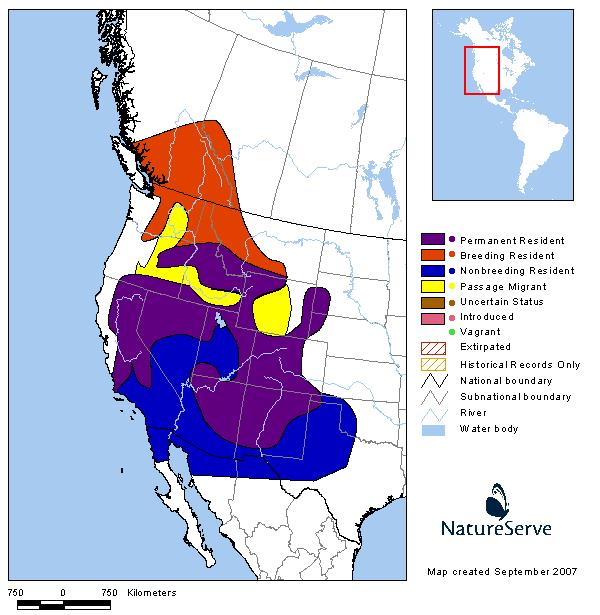
Observations in Montana Natural Heritage Program Database
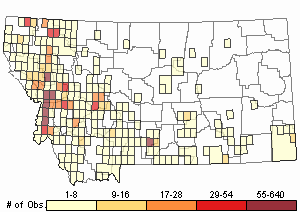
Number of Observations: 3166
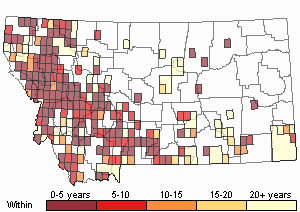
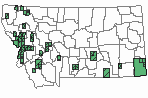
(Click on the following maps and charts to see full sized version)
Relative Density
Recency
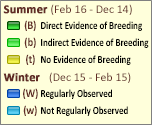
SUMMER (Feb 16 - Dec 14)
Direct Evidence of Breeding
Indirect Evidence of Breeding
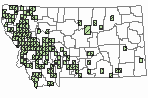
No Evidence of Breeding
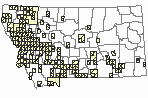
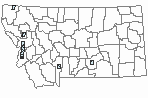
WINTER (Dec 15 - Feb 15)
Regularly Observed
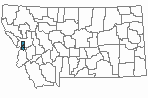
Not Regularly Observed

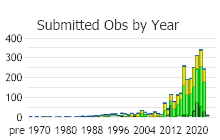
 (Observations spanning multiple months or years are excluded from time charts)
Migration
After breeding, Lewis's Woodpecker usually begin their southward fall migration in late August or early September (Tobalske 1997). In Montana, most of the migrating Lewis's Woodpecker observations have occurred in August. In fact, only a single observation of Lewis's Woodpecker exists from September (Montana Bird Distribution Committee 2012). Migratory routes to wintering areas are little known, as the species is a highly opportunistic feeder and may be following locally abundant food resources (Tobalske 1997). Spring migration usually begins in early April and most birds arrive on their breeding grounds by mid-May. In Montana, the earliest spring record for Lewis's Woodpecker is from the Deer Lodge area in April. All other spring migration observations are from May (Montana Bird Distribution Committee 2012).
Habitat
In the Bozeman area, Lewis's Woodpeckers are known to occur in river bottom woods and forest edge habitats (Skarr 1969). Habitat information from other Lewis's Woodpecker sources state that the breeding habitat is open forest and woodland, often logged or burned, including oak and coniferous forest; primarily ponderosa pine (Pinus ponderosa), riparian woodland and orchards, and less commonly in pinyon-juniper Pinus spp.-Juniperus spp.) (American Ornithologists' Union 1983). Lewis's Woodpecker distribution is closely associated with open ponderosa pine forest in western North America, and is strongly associated with fire-maintained old-growth ponderosa pine (Diem and Zeveloff 1980, Tobalske 1997, Saab and Dudley 1998).
Important habitat features include an open tree canopy, a brushy understory with ground cover, dead trees for nest cavities, dead or downed woody debris, perch sites, and abundant insects. Lewis's Woodpeckers use open ponderosa pine forests, open riparian woodlands dominated by cottonwood (Populus spp.), and logged or burned pine. They also use oak (Quercus spp.) woodlands, orchards, pinyon-juniper woodlands, other open coniferous forests, and agricultural lands. Apparently the species prefers open ponderosa pine at high elevations and open riparian forests at lower elevations (Bock 1970, Tobalske 1997). In the Blue Mountains of Oregon, they showed a preference for open stands near water (Thomas et al. 1979). Because the species catches insects from the air, perches near openings or in open canopy are important for foraging habitat (Bock 1970, Tobalske 1997).
Lewis's Woodpeckers often use burned pine forests, although suitability of post-fire habitats varies with the age, size, and intensity of the burn, density of remaining snags, and the geographic region. Birds may move to unburned stands once the young fledge (Block and Brennan 1987, Tobalske 1997, Saab and Dudley 1998). They have been generally considered a species of older burns rather than new ones, moving in several years post-fire once dead trees begin to fall and brush develops, five to thirty years after fire (Bock 1970, Block and Brennan 1987, Caton 1996, Linder and Anderson 1998). However, on a two- to four-year-old burn in Idaho they were the most common cavity-nester, and occurred in the highest nesting densities ever recorded for the species (Saab and Dudley 1998). As habitat suitability declines, however, numbers decline. For example, in Wyoming, the species was more common in a seven-year-old burn than in a twenty-year-old burn (Linder and Anderson 1998). Overall, suitable conditions include an open canopy, availability of nest cavities and perches, abundant arthropod prey, and a shrubby understory (Linder and Anderson 1998, Saab and Dudley 1998).
Unlike other woodpeckers, Lewis's Woodpeckers are not morphologically well adapted to excavate cavities in hard wood. They tend to nest in a natural cavity, abandoned Northern Flicker (Colaptes auratus) hole, or previously used cavity, 1 to 52 meters above ground. Sometimes they will excavate a new cavity in a soft snag (standing dead tree), dead branch of a living tree, or rotting utility pole (Harrison 1979, Tobalske 1997). The mated pair may return to the same nest site in successive years. On partially logged burns with high nesting densities in Idaho, nest sites were characterized by the presence of large, soft snags and an average of 62 snags per hectare that had more than 23-centimeter diameter at breast height (dbh) (Saab and Dudley 1998).
In late summer, wandering flocks move from valleys into mountains or from breeding habitat to orchards. In winter, they use oak woodlands and nut and fruit orchards. An important habitat feature in many wintering areas is the availability of storage sites for grains or mast, such as tree bark (e.g. bark of mature cottonwood trees) or power poles with desiccation cracks (Bock 1970, Tobalske 1997). In southwestern Arizona and southeastern California, Lewis's Woodpeckers may use scrub oak, pecan orchards, and cottonwoods, but more study is needed in this area (Bock 1970). In Mexico, they use open and semi-open woodlands, especially those with oaks (Howell and Webb 1995).
National Vegetation Classification System Groups Associated with this Species
Forest and Woodland
Low Elevation - Xeric Forest and Woodland
Montane - Subalpine Forest and Woodland
Wetland and Riparian
Riparian and Wetland Forest
Riparian Shrubland
Recently Disturbed or Modified
Insect-Killed Forest
Recently Burned
Food Habits
No specific information on food habits for Lewis's Woodpecker is available for Montana. Information from studies in other areas of the species' range indicate that Lewis's Woodpeckers feed on adult emergent insects (e.g., ants, beetles, flies, grasshoppers, tent caterpillars, mayflies) in summer, and ripe fruit and nuts in fall and winter. They are opportunistic and may respond to insect outbreaks and grasshopper swarms by increasing breeding densities. Unlike other woodpeckers, the Lewis's Woodpecker does not bore for insects but will flycatch and glean insects from tree branches or trunks; they also drop from a perch to capture insects on the ground. The species especially favors acorns and commercial nuts and fruit in fall and winter, and caches food in natural crevices such as tree bark and desiccation cracks in utility poles, tailoring food to fit crevices. They also eat huckleberry, twinberry, currant, mountain ash and chokecherries (Bock 1970, Tobalske 1997). In some areas, wintering birds rely more on insects than on cached food (Hadow 1973).
Ecology
There is very little ecological information from Montana. Lewis's Woodpeckers were reported as less common in the Bozeman area in the 1960s than in the 1880s, and less common near Fortine in the 1970s than before 1945 (Skaar 1969). Other ecological information comes from work in other areas of the species' range. Lewis's Woodpeckers will aggressively defend food caches and they are territorial in immediate space around nest sites toward Red-headed Woodpeckers (Melanerpes erythrocephalus) and other Lewis's Woodpeckers; however, they may nest semi-gregariously where several nest cavities are close together (Bock 1970, Bock et al. 1971, Tobalske 1997). Breeding season territories were reported to vary between 1 and 6 hectares in the Blue Mountains of Washington and Oregon (Thomas et al. 1979). Foraging home ranges broadly overlap and large numbers of birds may forage together where there is a local abundance of food (Tobalske 1997).
Reproductive Characteristics
Little information exists regarding Lewis's Woodpecker reproduction in Montana. Near Fortine, eggs were incubated during June. Dates for young in the nest range from June 22 to August 4. However, information from other areas where Lewis's Woodpeckers occur indicates that they form a life-long pair bond. The clutch size is five to nine (usually six to seven). Incubation, by both sexes, lasts 13 to 14 days. Young can fly 28 to 34 days after hatching (Terres 1980, Ehrlich et al. 1988).
Management
No known active management is ongoing for Lewis's Woodpecker in the state. However, management for Lewis's Woodpeckers in dry forests fits very well with the management needs for Flammulated Owls. The landscape-level needs of the Flammulated Owl would probably accommodate any habitat-area needs of Lewis's Woodpeckers. Specific needs of the Lewis's Woodpecker at the microsite and site level could be met in the form of interspersed zones of shrubby understory within the overall habitat mosaic (Casey 2000). Recommendations for snag retention in forest management plans have been developed (Thomas et al. 1979). To sustain a maximum density of Lewis's Woodpeckers (16.6 pairs per hectare) a density of 249 snags per 100 hectare, more than 30.4 cm in diameter at breast height (dbh), and more than 9 meters in height must be maintained in ponderosa pine, riparian cottonwood and mixed-conifer forest (Thomas et al. 1979).
Stewardship Responsibility
References
- Literature Cited AboveLegend:
 View Online Publication
 Block, W.M. and L.A. Brennan. 1987. Characteristics of Lewis's woodpecker habitat on the Modoc Plateau, California. Western Birds 18:209-212.
- Bock, C. E. 1970. The ecology and behavior of the Lewis’ Woodpecker (Asyndesmus lewis). University of California Publications in Zoology 92:1-100.
- Bock, C.E., H.H. Hadow, and P. Somers. 1971. Relations between Lewis's and red-headed woodpeckers in southeastern Colorado. Wilson Bulletin 83:237-248.
- Casey, D. 2000. Partners in Flight Draft Bird Conservation Plan Montana. Version 1.0. 287 pp.
- Caton, E. M. 1996. Effects of fire and salvage logging on the cavity-nesting bird community in northwestern Montana. Ph.D. dissertation, University of Montana, Missoula, MT. 115 pp.
- Diem, K. L. and S. I. Zeveloff. 1980. Ponderosa pine bird communities. In: R. M. DeGraff and N. G. Tilghman, eds. Workshop Proceedings: Management of western forests and grasslands for nongame birds. USDA. Forest Service General Technical Report INT-86. p. 170-197.
- Ehrlich, P., D. Dobkin, and D. Wheye. 1988. The birder’s handbook: a field guide to the natural history of North American birds. Simon and Schuster Inc. New York. 785 pp.
- Hadow, H. H. 1973. Winter ecology of migrant and resident Lewis's woodpeckers in southeastern Colorado. Condor 75:210-224.
- Harrison, H.H. 1979. A field guide to western birds nests. Houghton Mifflin Company, Boston, MA. 279 pp.
- Howell, S. N. G., and S. Webb. 1995. A guide to the birds of Mexico and northern Central America. Oxford University Press, Oxford, United Kingdom.
- Linder, K. A. and S. H. Anderson. 1998. Nesting habitat of Lewis's woodpeckers in southeastern Wyoming. Journal of Field Ornithology 69(1):109-116.
- Marks, J.S., P. Hendricks, and D. Casey. 2016. Birds of Montana. Arrington, VA. Buteo Books. 659 pages.
- Montana Bird Distribution Committee. 2012. P.D. Skaar's Montana bird distribution. 7th Edition. Montana Audubon, Helena, Montana. 208 pp. + foldout map.
- Saab, V. A. and J. G. Dudley. 1998. Responses of cavity-nesting birds to stand-replacement fore and salvage logging in ponderosa pine/Douglas-fir forests of southwestern Idaho. USDA Forest Service Rocky Mountains Research Station Research Paper RMRS-RP-11, Ogden, ID.
- Sibley, D.A. 2000. The Sibley guide to birds. National Audubon Society and Alfred A. Knopf, Inc., New York, NY. 544 pp.
- Skaar, P.D. 1969. Birds of the Bozeman latilong: a compilation of data concerning the birds which occur between 45 and 46 N. latitude and 111 and 112 W. longitude, with current lists for Idaho, Montana, Wyoming, impinging Montana counties and Yellowstone National Park. Bozeman, MT. 132 p.
- Terres, J.K. 1980. The Audubon Society encyclopedia of North American birds. Alfred A. Knopf, New York. 1109 pp.
- Thomas, J. W., R. G. Anderson, C. Maser, and E. L. Bull. 1979. Snags. In: J. W. Thomas, ed. Wildlife Habitats in Managed Forests: the Blue Mountains of Oregon and Washington. U.S.D.A. Handbook 553. pp. 60-77.
- Additional ReferencesLegend: View Online Publication
Do you know of a citation we're missing?- American Ornithologists Union. 1983. Checklist of North American birds, 6th Edition. 877 PP.
- American Ornithologists’ Union [AOU]. 1998. Check-list of North American birds, 7th edition. American Ornithologists’ Union, Washington, D.C. 829 p.
- Blake, William M. 2018. Lewis' Woodpecker nest success and habitat selection in cottonwood floodplain versus burned conifer forests. M.S. Thesis. University of Montana. Missoula, MT.
- Dobkin, D. S. 1992. Neotropical migrant landbirds in the Northern Rockies and Great Plains. U.S.D.A. For. Serv. N. Region Publ. R1-93-34. Missoula, Mont.
- Ehrlich, P.R., D.S. Dobkin, and D. Wheye. 1988. The birder's handbook: a field guide to the natural history of North American birds. Simon and Shuster, Inc., New York. xxx + 785 pp.
- Eng, R.L. 1976. Wildlife Baseline Study [for West Fork of the Stillwater and Picket Pin drainages]
- Erhlich, P.R., D.S. Doblin, and D. Wheye. 1992. Birds in jeopardy: the imperiled and extinct birds of the United States and Canada, including Hawaii and Puerto Rico. Stanford University Press, Stanford, California.
- Fink, D., K.V. Rosenberg, F.A. La Sorte, M.J. Iliff, C. Wood, and S. Kelling. 2013. Species distribution modeling of priority bird species on Bureau of Land Management lands to determine stewardship responsibility for conservation planning. Ithaca, NY: Cornell Lab of Ornithology. 224 p.
- Flath, Dennis and David Dickson. 1994 Systematic wildlife observations on the Blackfoot-Clearwater Wildlife Management Area 1991-1993. Montana Department of Fish, Wildlife and Parks.
- Hays, R., R.L. Eng, and C.V. Davis (preparers). 1984. A list of Montana birds. Helena, MT: MT Dept. of Fish, Wildlife & Parks.
- Hejl, S.J., R.L. Hutto, C.R. Preston, and D.M. Finch. 1995. The effects of silvicultural treatments on forest birds in the Rocky Mountains. pp. 220-244 In: T.E. Martin and D.M. Finch (eds). Ecology and Management of Neotropical Migratory Birds. New York, NY: Oxford Univ. Press. 489 p.
- Hoffmann, R.S. 1960. Summer birds of the Little Belt Mountains, Montana. Missoula, MT: Occasional Papers of Montana State University No. 1. 18 p.
- Hoffmann, R.S., R.L. Hand, and P.L. Wright. 1959. Recent bird records from western Montana. The Condor 61(2):147-151.
- Humphris, Michael., 1990, Wildlife Monitoring Report. Spring Creek Coal Company 1990 Mining Annual Report. Appendix I. April 11, 1990.
- Johnsgard, P.A. 1992. Birds of the Rocky Mountains with particular reference to national parks in the northern Rocky Mountain region. Lincoln: University of Nebraska Press. xi + 504 pp.
- Joslin, Gayle, and Heidi B. Youmans. 1999. Effects of recreation on Rocky Mountain wildlife: a review for Montana. [Montana]: Montana Chapter of the Wildlife Society.
- Lenard, S., J. Carlson, J. Ellis, C. Jones, and C. Tilly. 2003. P. D. Skaar's Montana bird distribution, 6th edition. Montana Audubon, Helena, MT. 144 pp.
- MT Fish, Wildlife & Parks. No date. Blackfoot-Clearwater Wildlife Management Area checklist.
- Newlon, K.R. 2005. Demography of Lewis's Woodpecker, breeding bird densities, and riparian Aspen integrity in a grazed landscape. M.Sc. Thesis. Bozeman, MT: Montana State University. 101 p.
- Oechsli, L.M. 2000. Ex-urban development in the Rocky Mountain West: consequences for native vegetation, wildlife diversity, and land-use planning in Big Sky, Montana. M.Sc. Thesis. Montana State University, Bozeman. 73 p.
- Powder River Eagle Studies, Inc., Gillette, WY., 1995, Spring Creek Mine 1994 Wildlife Monitoring Studies. 4/94 to 4/95. Spring Creek Coal Company 1995 Mining Annual Report. Appendix I. May 1995.
- Richmond, C.W. and F.H. Knowlton. 1894. Birds of south-central Montana. Auk 11:298-308.
- Sauer, J.R., J.E. Hines, G. Gough, I. Thomas, and B.G. Peterjohn. 1997. July 29-last update. The North American Breeding Bird Survey Results and Analysis. Version 96.4. Patuxent Wildlife Research Center, Laurel, MD.
- Sauer, J.R., S. Schwartz, and B. Hoover. 1996. The Christmas Bird Count Home Page. Version 95.1 U.S.G.S. Biological Resource Division, Patuxent Wildlife Research Center, Laurel, MD.
- Sibley, D. 2014. The Sibley guide to birds. Alfred A. Knopf, New York, NY. 598 pp.
- Skaar, P. D., D. L. Flath, and L. S. Thompson. 1985. Montana bird distribution. Montana Academy of Sciences Monograph 3(44): ii-69.
- Sousa, P. J. 1983. Habitat suitability models: Lewis' Woodpecker. Division of Biological Services, U. S. Fish and Wildlife Service, USDI Washington, D.C. 15 pp.
- Swan River National Wildlife Refuge. 1982. Birds of the Swan River NWR. Kalispell, MT: NW MT Fish and Wildlife Center pamphlet.
- Thomas, J. W. (ed). 1979. Wildlife habitats in managed forests: the Blue Mountains of Oregon and Washington. Agriculture Handbook 553, USDA, Forest Service, Wildlife Management Institute, Washington, DC. 512 pp.
- Thompson, Richard W., Western Resource Dev. Corp., Boulder, CO., 1996, Wildlife baseline report for the Montana [Montanore] Project, Lincoln and Sanders counties, Montana. In Application for a Hard Rock Operating Permit and Proposed Plan of Operation, Montanore Project, Lincoln and Sanders Counties, Montana. Vol. 5. Stroiazzo, John. Noranda Minerals Corp., Libby, MT. Revised September 1996.
- Thunderbird Wildlife Consulting, Inc., Gillette, WY., 2003, Spring Creek Mine 2002 Wildlife Monitoring. March 2003.
- Tobalske, B.W. 1997. Lewis's Woodpecker (Melanerpes lewis). Species Account Number 284. The Birds of North America Online (A. Poole, Ed.). Ithaca, NY: Cornell Laboratory of Ornithology; Retrieved 3/25/2008 from The Birds of North America Online database
- U.S. Fish and Wildlife Service. 2021. Birds of Conservation Concern 2021. United States Department of the Interior, U.S. Fish and Wildlife Service, Migratory Birds, Falls Church, Virginia.
- U.S. Forest Service. 1991. Forest and rangeland birds of the United States: Natural history and habitat use. U.S. Department of Agriculture, Forest Service Agricultural Handbook 688. 625 pages.
- Van Horn, R.C. 1993. Ferruginous Hawk and Prairie Falcon reproductive and behavioral responses to human activity near the Kevin Rim, Montana. M.Sc. Thesis. Bozeman, Montana: Montana State University. 86 p.
- Waage, Bruce C., 1995, Western Energy Company Rosebud Mine, Colstrip, Montana:1994 Annual Wildlife Monitoring Report; December 1, 1993 - November 30, 1994. February 27, 1995.
- Waage, Bruce C., 1996, Western Energy Company Rosebud Mine, Colstrip, Montana: 1995 Annual Wildlife Monitoring Report; December 1, 1994 - November 30, 1995. February 28, 1996.
- Walcheck, K.C. 1999. The Lewis and Clark Expedition: Montana's First Bird Inventory Through the Eyes of Lewis and Clark. Lewis and Clark Interpretive Association. 48 pp.
- Waldt, R. 1995. The Pine Butte Swamp Preserve bird list. Choteau, MT: The Nature Conservancy. Updated August 1995.
- Watts, C.R. and L.C. Eichhorn. 1981. Changes in the birds of central Montana. Proceedings of the Montana Academy of Sciences 40:31-40.
- Western Technology and Engineering, Inc. (WESTECH)., 1990, Wildlife Monitoring: Absaloka Mine Area Annual Report, 1990. 12/21/89-12/20/90. Montana SMP 85005 R1. OSMP Montana 0007B. Febr. 15, 1991.
- Weydemeyer, W., and D. Weydemeyer. 1928. The woodpeckers of Lincoln County, Montana. Condor 30:339-346.
- Web Search Engines for Articles on "Lewis's Woodpecker"
- Additional Sources of Information Related to "Birds"