View in other NatureServe Network Field Guides
NatureServe
Montana
Utah
Wyoming
Idaho
Wisconsin
British Columbia
South Carolina
Yukon
California
New York
Tufted Club-rush - Trichophorum cespitosum
Other Names:
Scirpus cespitosus, Trichophorum caespitosum
State Rank Reason (see State Rank above)
Rare in Montana, where it is currently documented from over a dozen fens and wet meadows in the mountainous portion of western Montana.
- Details on Status Ranking and Review
Population Size
Score1 - Moderate: Generally 10,000-100,000 individuals.
Range Extent
Score1 - Peripheral, Disjunct or Sporadic Distribution in MT: Widespread species that is peripheral, disjunct or sporadically distributed within MT such that it occurs in <5% of the state (<7,500 sq. miles or the combined area of Beaverhead and Ravalli Counties) or is restricted to 4-5 sub-basins.
Area of Occupancy
Score1 - Moderate: Generally occurring in 11-25 Subwatersheds (6th Code HUC’s).
Environmental Specificity
Score2 - High: Species is restricted to a highly specialized and limited habitat and is typically dependent upon unaltered, high-quality habitat (C Values of 8-10).
Trends
Score0-1 - Stable to Minor Declines:
CommentTrends unknown, though populations are likely stable or experiencing only minor declines.
Threats
Score0-1 - Low to Medium.
Intrinsic Vulnerability
Score0-1 - Low to Moderate Vulnerability.
Raw Conservation Status Score
Score
5 to 8 total points scored out of a possible 19.
General Description
Plants forming large hemispheric tussocks. Stems terete, 10–40 cm, densely clustered. Leaf blades reduced to scales at the base, often with 1 short blade on the lower stem, 1 mm or less wide. Spikelet 3–6 mm long with 2 to 4 flowers; awn of lowest bract barely longer than the spikelet. Scales 3–4 mm long, glabrous, brown, apiculate. Flowers: bristles 6, brown, barely exceeding the scale awn. Achene ca. 1.5 mm long (
Lesica et al. 2012. Manual of Montana Vascular Plants. BRIT Press. Fort Worth, TX).
Phenology
Mature fruit in July-August.
Diagnostic Characteristics
Trichophorum cespitosum could easily be mistaken for a species of Eleocharis; however, the former has spikelets subtended by a short-awned scale, whereas the latter do not. It resembles T. alpinum except for its smooth, round stems, and resembles T. pumilum except that it forms large, distinctive tussocks and has perianth bristles.
Species Range
Montana Range
Range Descriptions
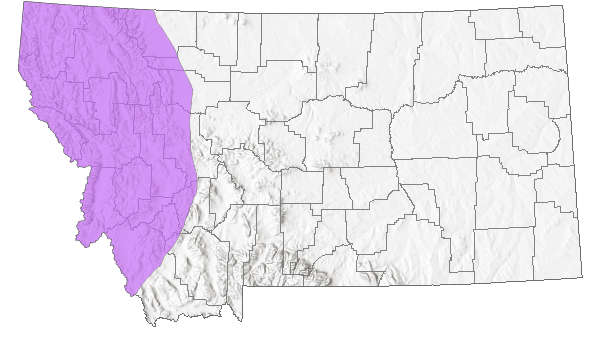
 Native
Range Comments
Circumboreal south to OR, ID, UT and MT (Lesica et al. 2012. Manual of Montana Vascular Plants. BRIT Press. Fort Worth, TX).
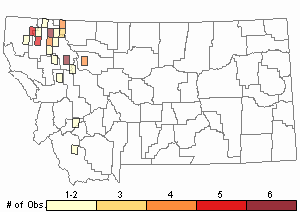
Observations in Montana Natural Heritage Program Database
Number of Observations: 51
(Click on the following maps and charts to see full sized version)
Map Help and Descriptions
Relative Density
Recency
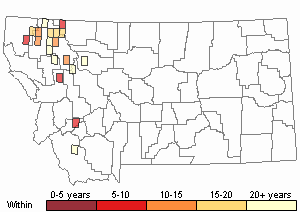

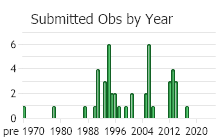
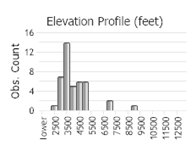 (Observations spanning multiple months or years are excluded from time charts)
Habitat
Wet meadows and sphagnum-dominated fens in the montane to alpine zones.
National Vegetation Classification System Groups Associated with this Species
Wetland and Riparian
Alpine Riparian and Wetland
Peatland
Wet Meadow and Marsh
Stewardship Responsibility
Threats or Limiting Factors
STATE THREAT SCORE REASON
Threat impact not assigned because threats are not known (MTNHP Threat Assessment 2021).
References
- Literature Cited AboveLegend:
 View Online Publication
- Lesica, P., M.T. Lavin, and P.F. Stickney. 2012. Manual of Montana Vascular Plants. Fort Worth, TX: BRIT Press. viii + 771 p.
 MTNHP Threat Assessment. 2021. State Threat Score Assignment and Assessment of Reported Threats from 2006 to 2021 for State-listed Vascular Plants. Botany Program, Montana Natural Heritage Program, Helena, Montana.
- Additional ReferencesLegend: View Online Publication
Do you know of a citation we're missing?- Lesica, P. 1991. The Rare Vascular Plants of Pine Butte Swamp Preserve. Unpublished Report to the Nature Conservancy. 15 Pp.
- Lesica, P. 1992. Monitoring the Scirpus cespitosis - Scirpus acutus ecotone at Pine Butte Swamp Preserve. The Nature Conservancy, Montana Field Office, Helena, Montana. 9 pp.
- Lesica, P., M.T. Lavin, and P.F. Stickney. 2022. Manual of Montana Vascular Plants, Second Edition. Fort Worth, TX: BRIT Press. viii + 779 p.
- Web Search Engines for Articles on "Tufted Club-rush"