View in other NatureServe Network Field Guides
NatureServe
Montana
Utah
Wyoming
Idaho
Wisconsin
British Columbia
South Carolina
Yukon
California
New York
Northern Myotis - Myotis septentrionalis
Other Names:
Northern Long-eared Myotis, Northern Long-eared Bat,
Myotis keenii septentrionalis
State Rank Reason (see State Rank above)
In Montana this species in known to occupy specific habitat within a limited range along the Missouri and Yellowstone river drainages near the North Dakota border. Populations of this species in the eastern US have undergone catastrophic declines due to White-Nose Syndrome, a fungal disease of bats. Although WNS is not known to be present in Montana, its eventual spread to the state presents a substantial threat to the persistence of this species.
- Details on Status Ranking and Review
Northern Myotis (Myotis septentrionalis) Conservation Status Review
Review Date = 09/24/2018
Range Extent
ScoreA - <100 km squared (less than about 40 square miles)
CommentRange is likely less than 250 square Kilometers if all habitat on the lower Missouri and Yellowstone drainages are occupied. Current known range is < 100 square Kilometers, but surveys are incomplete.
Long-term Trend
ScoreD - Moderate Decline (decline of 25-50%)
CommentHabitat has likely declined by more than 25% since European settlement. Species is found in riparian forest along major river drainages. Grazing and non-native species have impacted recruitment of cottonwood and other species within the ecosystem. Conversion of forest to agriculture has reduced roosting and foraging habitat.
Short-term Trend
ScoreU - Unknown. Short-term trend in population, range, area occupied, and number and condition of occurrences unknown.
CommentNo data on trends available. Species was known from one observation until 2016.
Threats
ScoreB - Moderate and imminent threat. Threat is moderate to severe and imminent for a significant proportion (20-60%) of the population or area.
CommentAlthough this species has suffered severe declines due to White-Nose Syndrome in the eastern US and Canada, it remains to be seen if differences in hibernacula used by western populations will change disease transmission dynamics and mitigate the effects of this disease on populations of this species in Montana. If impacts are similar to the east coast, extirpation is possible.
SeverityModerate - Major reduction of species population or long-term degradation or reduction of habitat in Montana, requiring 50-100 years for recovery.
CommentThe extent of WNS impacts to western bat species are currently unknown. If the disease dynamics are similar to the east coast, we may see declines of up to 100% for this species (High). Because many of our bats overwinter outside of caves, disease transmission and effects may differ and moderate population level impacts. Until we can quantify this better, the threat appears to be of Moderate severity, with a major reduction of population and recovery taking up to 100 years.
ScopeModerate - 20-60% of total population or area affected
CommentVery few of our bats hibernate in caves and mines so the extent of WNS impacts to the state’s population are difficult to quantify. Given the disease’s impacts on this species in other regions, WNS will likely impact more than 20% of the population.
ImmediacyModerate - Threat is likely to be operational within 2-5 years.
CommentBased on the average rate of spread, we should expect to detect WNS or the causal pathogen within 5 years.
Intrinsic Vulnerability
ScoreB - Moderately Vulnerable. Species exhibits moderate age of maturity, frequency of reproduction, and/or fecundity such that populations generally tend to recover from decreases in abundance over a period of several years (on the order of 5-20 years or 2-5 generations); or species has moderate dispersal capability such that extirpated populations generally become reestablished through natural recolonization (unaided by humans).
CommentSpecies is long lived, and has low fecundity. As these animals can fly, dispersal to and recolonization of extirpated populations is possible.
Environmental Specificity
ScoreB - Narrow. Specialist. Specific habitat(s) or other abiotic and/or biotic factors (see above) are used or required by the Element, but these key requirements are common and within the generalized range of the species within the area of interest.
CommentSpecies appears to be restricted to riparian forest during the active season and mines or rock outcrops for hibernation
Raw Conservation Status Score
Score
3.5 + -0.5 (geographic distribution) + 0 (environmental specificity) + 0 (long-term trend) + -0.75 (threats) = 2.25
General Description
Northern Myotis has relatively long ears (14-19 mm) extending < 5mm beyond the nose when pushed forward, a long pointed tragus, forearm length 34-38 mm, hind foot length 8-10 mm and tail length 35-42 mm; the calcar lacks a prominent keel (but a slight keel may be present), and the fringe of the tail is hairless or with only a few sparse hairs. Pelage and membranes are brown and usually the same color. Females are generally larger and heavier than males. Dental formula is I 2/3, C 1/1, P 3/3, M 3/3 (Nagorsen and Brigham 1993, Caceres and Barclay 2000, Adams 2003).
Diagnostic Characteristics
Northern Myotis was formerly considered a subspecies of Keen's Myotis (Myotis keenii). Northern Myotis can be distinguished in the hand from Myotis lucifugus by the longer ears (extending beyond the snout when pushed forward) and tragus and relatively longer tail; pelage color is similar, but less glossy than in Myotis lucifugus. Characteristic frequency of call is slightly higher than for Myotis lucifugus (41-45 kHz vs. 37-43 kHz) and high frequency calls may reach to 120 kHz. Myotis evotis has darker membranes and paler pelage, and the ears are longer; characteristic frequency of calls is lower (33-38 kHz) than for Northern Myotis.
Species Range
Montana Range
Range Descriptions
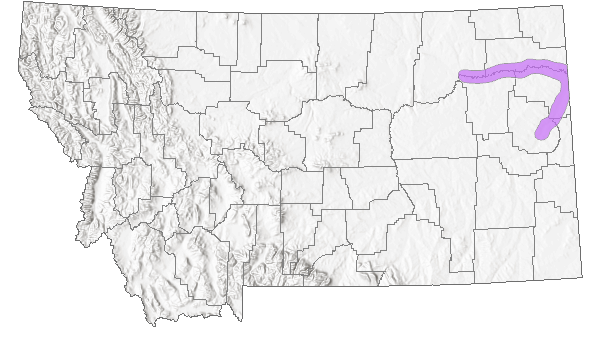
 Native
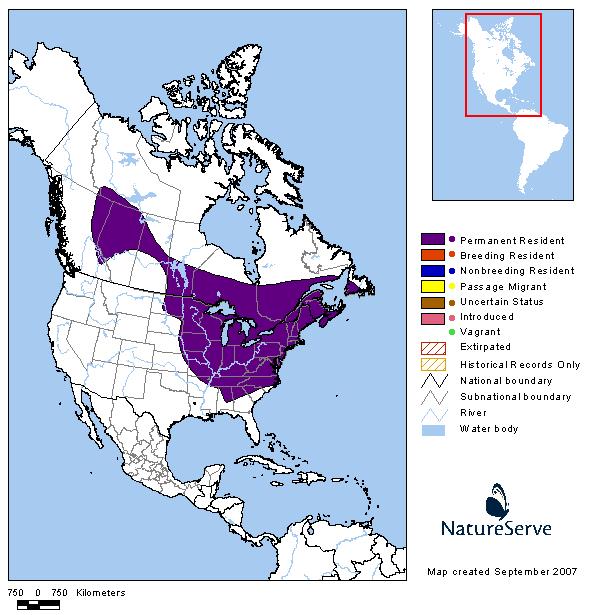
Western Hemisphere Range
Observations in Montana Natural Heritage Program Database
Number of Observations: 83
(Click on the following maps and charts to see full sized version)
Map Help and Descriptions
Relative Density
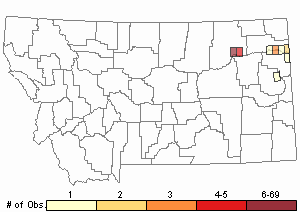
Recency
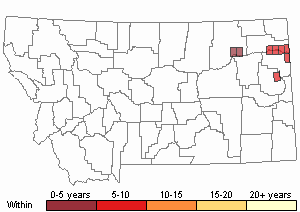
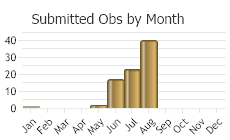

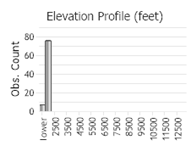 (Observations spanning multiple months or years are excluded from time charts)
Migration
The species may be partially migratory in far eastern Montana between riparian forest and hibernacula in mines or other suitable features.
Habitat
In Montana, Northern Myotis have been located hibernating in an abandoned mine in riverbreaks habitat in Richland County (Swenson and Shanks 1979). Northern Myotis prefers cooler hibernacula than Myotis lucifugus and selects narrow crevices in which to hibernate. Summer day roosts are often in cavities or crevices behind peeling bark in trees, usually in tall, wide-diameter and partially dead hardwoods (Caceres and Barclay 2000). All active season captures within the state have been in or near riparian forest dominated by cottonwood (Populus spp.) and green ash (Fraxinus pennsylvanica) typical of the Great Plains Floodplain Ecological System.
Ecological Systems Associated with this Species
- Details on Creation and Suggested Uses and Limitations
How Associations Were Made
We associated the use and habitat quality (common or occasional) of each of the 82 ecological systems mapped in Montana for
vertebrate animal species that regularly breed, overwinter, or migrate through the state by:
- Using personal observations and reviewing literature that summarize the breeding, overwintering, or migratory habitat requirements of each species (Dobkin 1992, Hart et al. 1998, Hutto and Young 1999, Maxell 2000, Foresman 2012, Adams 2003, and Werner et al. 2004);
- Evaluating structural characteristics and distribution of each ecological system relative to the species' range and habitat requirements;
- Examining the observation records for each species in the state-wide point observation database associated with each ecological system;
- Calculating the percentage of observations associated with each ecological system relative to the percent of Montana covered by each ecological system to get a measure of "observations versus availability of habitat".
Species that breed in Montana were only evaluated for breeding habitat use, species that only overwinter in Montana were only evaluated for overwintering habitat use, and species that only migrate through Montana were only evaluated for migratory habitat use.
In general, species were listed as associated with an ecological system if structural characteristics of used habitat documented in the literature were present in the ecological system or large numbers of point observations were associated with the ecological system.
However, species were not listed as associated with an ecological system if there was no support in the literature for use of structural characteristics in an ecological system,
even if point observations were associated with that system.
Common versus occasional association with an ecological system was assigned based on the degree to which the structural characteristics of an ecological system matched the preferred structural habitat characteristics for each species as represented in scientific literature.
The percentage of observations associated with each ecological system relative to the percent of Montana covered by each ecological system was also used to guide assignment of common versus occasional association.
If you have any questions or comments on species associations with ecological systems, please contact the Montana Natural Heritage Program's Senior Zoologist.
Suggested Uses and Limitations
Species associations with ecological systems should be used to generate potential lists of species that may occupy broader landscapes for the purposes of landscape-level planning.
These potential lists of species should not be used in place of documented occurrences of species (this information can be requested at:
mtnhp.org/requests) or systematic surveys for species and evaluations of habitat at a local site level by trained biologists.
Users of this information should be aware that the land cover data used to generate species associations is based on imagery from the late 1990s and early 2000s and was only intended to be used at broader landscape scales.
Land cover mapping accuracy is particularly problematic when the systems occur as small patches or where the land cover types have been altered over the past decade.
Thus, particular caution should be used when using the associations in assessments of smaller areas (e.g., evaluations of public land survey sections).
Finally, although a species may be associated with a particular ecological system within its known geographic range, portions of that ecological system may occur outside of the species' known geographic range.
Literature Cited
- Adams, R.A. 2003. Bats of the Rocky Mountain West; natural history, ecology, and conservation. Boulder, CO: University Press of Colorado. 289 p.
- Dobkin, D. S. 1992. Neotropical migrant land birds in the Northern Rockies and Great Plains. USDA Forest Service, Northern Region. Publication No. R1-93-34. Missoula, MT.
- Foresman, K.R. 2012. Mammals of Montana. Second edition. Mountain Press Publishing, Missoula, Montana. 429 pp.
- Hart, M.M., W.A. Williams, P.C. Thornton, K.P. McLaughlin, C.M. Tobalske, B.A. Maxell, D.P. Hendricks, C.R. Peterson, and R.L. Redmond. 1998. Montana atlas of terrestrial vertebrates. Montana Cooperative Wildlife Research Unit, University of Montana, Missoula, MT. 1302 p.
- Hutto, R.L. and J.S. Young. 1999. Habitat relationships of landbirds in the Northern Region, USDA Forest Service, Rocky Mountain Research Station RMRS-GTR-32. 72 p.
- Maxell, B.A. 2000. Management of Montana's amphibians: a review of factors that may present a risk to population viability and accounts on the identification, distribution, taxonomy, habitat use, natural history, and the status and conservation of individual species. Report to U.S. Forest Service Region 1. Missoula, MT: Wildlife Biology Program, University of Montana. 161 p.
- Werner, J.K., B.A. Maxell, P. Hendricks, and D. Flath. 2004. Amphibians and reptiles of Montana. Missoula, MT: Mountain Press Publishing Company. 262 p.
Food Habits
No food habits information is available from Montana. Range-wide, Northern Myotis feed on a variety of insects, oftentimes gleaning insects from foliage and sometimes from the ground (Caceres and Barclay 2000).
Ecology
No information available for the Northern Myotis from Montana. During the summer, these bats emerge shortly after sunset to forage. Their activity is bimodal, peaking 1 to 2 hours and 7 to 8 hours after sunset. They are less gregarious than M. lucifugus or other Myotis species. They tend to be solitary or found in smaller clusters than other Myotis species; one of the largest hibernating clusters was of 300 individuals mixed with about 1000 Myotis lucifugus. It also may be overlooked in hibernacula as it tends to occupy deep and narrow crevices. Longevity record is 18.5 years. Predators of Northern Myotis have not been reported (Caceres and Barclay 2000).
Reproductive Characteristics
No information from Montana. Elsewhere within the range, copulation occurs at hibernacula from late July to October (Caceres and Barclay 2000). Parturition in Montana may occur in late June or July; lactating females reported from late July through August in the Black Hills, South Dakota (Clark and Stromberg 1987).
Management
The Northern Long-eared Bat (a.k.a Northern Myotis) was listed as Endangered under the Endangered Species Act on March 30, 2023, due to population declines resulting from the effects of white-nose syndrome (WNS). More information regarding the federal status of the species and federal regulations applicable to the species can be found on the
U.S. Fish and Wildlife Service's Northern Long-eared Bat web page or U.S. Fish and Wildlife Service's
Environmental Conservation Online System Species Profile.
Protection of bat winter roosting habitat (abandoned mines and caves) with gating should be beneficial to this species. Protection guidelines and management protocols designated for Townsend's Big-eared Bat (Pierson et al. 1999) are also appropriate for Northern Myotis, especially during winter, and can be used as a default protocol. So little is known about Northern Myotis in Montana, including its distribution and relative abundance, that standardized surveys of potential roosts and foraging habitats are desirable as the first step to identifying the spatial and temporal context in which this species is present in the state. This basic information will make it easier to design and implement appropriate and effective conservation guidelines for the protection of important habitats and roosts.
References
- Literature Cited AboveLegend:
 View Online Publication
- Adams, R.A. 2003. Bats of the Rocky Mountain West: natural history, ecology and conservation. University Press of Colorado: Boulder, CO. 289 pp.
- Caceres, M.C. and R.M.R. Barclay. 2000. Myotis septentrionalis. Mammalian Species. 634:1-4.
 Clark, S.G. and M.R. Stromberg. 1987. Mammals in Wyoming. University of Kansas Museum of Natural History, Public Education Series Number 10. xii + 314 pp.
- Nagorsen, D.W. and R.M. Brigham. 1993. Bats of British Columbia. Volume I. The Mammals of British Columbia. UBC Press, Vancouver. 164 pp.
- Pierson, E.D., M.C. Wackenhut, J.S. Altenbach, P. Bradley, P. Call, D.L. Genter, C.E. Harris, B.L. Keller, B. Lengus, L. Lewis, and B. Luce. 1999. Species conservation assessment and strategy for Townsend's big-eared bat (Corynorhinus townsendii townsendii and Corynorhinus townsendii pallescens). Idaho Conservation Effort, Idaho Department of Fish and Game, Boise, Idaho. 68 pp.
- Swenson, J.E. and G.F. Shanks, Jr. 1979. Noteworthy records of bats from northeastern Montana. Journal of Mammalogy. 60(3): 650-652
- U.S. Fish and Wildlife Service. 2016. Endangered and Threatened Wildlife and Plants; 4(d) Rule for the Northern Long-Eared Bat. Federal Register 81(9): 1900-1922.
- United States Fish and Wildlife Service. 2015b. Endangered and Threatened wildlife and plants; Threatened Species Status for the Northern Long-Eared Bat with 4(d) Rule; Final Rule and Interim Rule. Federal Register 80:17974-18033.
- Additional ReferencesLegend: View Online Publication
Do you know of a citation we're missing?- Abernethy, I.M., M.D. Andersen, and D.A. Keinath. 2012. Bats of southern Wyoming: distribution and migration year 2 report. Prepared for the USDI Bureau of Land Management by the Wyoming Natural Diversity Database, University of Wyoming, Laramie, Wyoming.
- Agnarsson, I., C.M. Zambrana-Torrelio, N.P. Flores-Saldana, L.J. May-Collado. 2011. A time-calibrated species-level phylogeny of bats (Chiroptera, Mammalia). PLoS Currents Tree of Life. Edition1. RRN1212.
- Agosta, S.J., D. Morton, B.D. Marsh, and K.M. Kuhn. 2005. Nightly, Seasonal, and Yearly Patterns of Bat Activity at Night Roosts in the Central Appalachians. Journal of Mammalogy 86(6): 1210-1219.
- Almberg, E., D. Bachen, C. Stratton, S. Hilty, M. Becker, J. Ramsey, and K. Smucker. 2023. Montana's 2023 annual white-nose syndrome surveillance and bat monitoring report. Montana Fish, Wildlife & Parks. 21 p.
- Amichai, E., G. Blumrosen, and Y. Yovel. 2015. Calling louder and longer: how bats use biosonar under severe acoustic interference from other bats. Proceedings of the Royal Society B: Biological Sciences, The Royal Society 282(1821): 20152064.
- Arnett, E.B. 2007. Presence, relative abundance, and resource selection of bats in managed forest landscapes in western Oregon. Ph.D. dissertation, Oregon State University, Corvallis, Oregon.
- Arnold, B.D. 2007. Population Structure and Sex-biased Dispersal in the Forest Dwelling Vespertilionid Bat, Myotis septentrionalis. American Midland Naturalist 157(2): 374-384.
- Bachen, D.A., A.L. McEwan, B.O. Burkholder, S.L. Hilty, S.A. Blum, and B.A. Maxell.. 2018. Bats of Montana: Identification and Natural History. Report to Montana Department of Environmental Quality. Montana Natural Heritage Program. Helena, MT. 111pp.
- Bachen, D.A., and B.A. Maxell. 2014. Distribution and status of bird, small mammal, reptile, and amphibian species, South Dakota Field Office-BLM. Report to the Bureau of Land Management, South Dakota Field Office. Montana Natural Heritage Program, Helena, Montana 25 pp. plus appendices.
- Baker, R.H. and C.J. Phillips. 1965. Mammals from El Nevado de Colima, Mexico. Journal of Mammalogy 46(4): 691-693.
- Barclay, R.M.R. 1991. Population Structure of Temperate Zone Insectivorous Bats in Relation to Foraging Behavior and Energy Demand. Journal of Animal Ecology 60(1): 165.
- Barnhart, P.R., and E.H. Gillam. 2014. The impact of sampling method on maximum entropy species distribution modeling for bats. Acta Chiropterologica 16(1): 241-248.
- Bat Conservation International. G4 Harp Trap: Assembly and Advice. 8 p.
- Baxter, D.M., J.M. Psyllakis, M.P. Gillingham, and E.L. O'Brien. 2006. Behavioural response of bats to perceived predation risk while foraging. Ethology 112(10): 977-983.
- Bell, J.F., G.J. Moore, G.H. Raymond, and C.E. Tibbs. 1962. Characteristics of Rabies in Bats in Montana. American Journal of Public Health 52(8): 1293-1301.
- Bell, J.F., W.J. Hadlow and W.L. Jellison. 1957. A survey of chiropteran rabies in western Montana. Public Health Reports. 72(1): 16-18.
- Bender, M.J. and G.D. Hartman. 2015. Bat Activity Increases with Barometric Pressure and Temperature During Autumn in Central Georgia. Southeastern Naturalist 14(2): 231-242.
- Benedict, R.A. 2004. Reproductive activity and distribution of bats in Nebraska. Western North American Naturalist 64(2): 231-248.
- Berthinussen, A. and J. Altringham. 2012. The effect of a major road on bat activity and diversity. Journal of Applied Ecology 49(1): 82-89.
- Bogan, M.A., and K. Geluso. 1999. Bat roosts and historic structures on National Park Service lands in the Rocky Mountain region. Albuquerque, NM: U.S. Geological Survey, Midcontinent Ecological Science Center, Dept. of Biology, the University of New Mexico. Unpublished report. 25 pp
- Brack, V. 2007. Temperatures and Locations Used by Hibernating Bats, Including Myotis sodalis (Indiana Bat), in a Limestone Mine: Implications for Conservation and Management. Environmental Management 40(5): 739-746.
- Brandon, R. A. 1961. Observations of young keen bats. Journal of Mammalogy 42(3):400-1.
- British Columbia Ministry of Environment, Lands, and Parks. 1998. Inventory Methods for Bats; Standards for Components of British Columbia's Biodiversity No. 20. Prepared for the Terrestrial Ecosystems Task Force Resources Inventory Committee. Version 2.0. 58 p.
- Broders, H.G. and C.J. Garroway. 2007. Nonrandom association patterns at northern long-eared bat maternity roosts. Canadian Journal of Zoology 85(9): 956-964.
- Broders, H.G. and G.J. Forbes. 2004. Interspecific and Intersexual Variation in Roost-Site Selection of Northern Long-eared and Little Brown Bats in the Greater Fundy National Park Ecosystem. Journal of Wildlife Management 68(3): 602-610.
- Broders, H.G., C.S. Findlay, and L. Zheng. 2004. Effects of Clutter on Echolocation Call Structure of Myotis septentrionalis and M. lucifugus. Journal of Mammalogy 85(2): 273-281.
- Broders, H.G., G.J. Forbes, S. Woodley, and I.D. Thompson. 2006. Range Extent and Stand Selection for Roosting and Foraging in Forest-Dwelling Northern Long-Eared Bats and Little Brown Bats in the Greater Fundy Ecosystem, New Brunswick. Journal of Wildlife Management 70(5): 1174-1184.
- Broders, H.G., L.J. Farrow, R.N. Hearn, L.M. Lawrence, and G.J. Forbes. 2014. Stable isotopes reveal that little brown bats have a broader dietary niche than northern long-eared bats. Acta Chiropterologica 16(2): 315-325.
- Brooks, R.T. W.M. Ford. 2005. Bat Activity in a Forest Landscape of Central Massachusetts. Northeastern Naturalist 12(4): 447-462.
- Burns, L.E. and H.G. Broders. 2015. Maximizing mating opportunities: higher autumn swarming activity in male versus female Myotis bats. Journal of Mammalogy 96(6): 1326-1336.
- Burns, L.E. and H.G. Broders. 2015. Who swarms with whom? Group dynamics of Myotis bats during autumn swarming. Behavioral Ecology 26(3): 866-876.
- Burns, L.E., J.L. Segers, and H.G. Broders. 2015. Bat Activity and Community Composition in the Northern Boreal Forest of South-central Labrador, Canada. Northeastern Naturalist 22(1): 32-40.
- Butts, T. 1997. Bat surveys Indian Creek Canyon, Elkhorn Mountains, Montana. Continental Divide Wildlife Consulting. Helena, MT 32 pg.
- Butts, T.W. 1993. A preliminary survey of the bats of the Deerlodge National Forest, Montana: 1991. Montana Natural Heritage Program. Helena, MT. 35 pp.
- Butts, T.W. 1993. A survey of the bats of the Deerlodge National Forest Montana: 1992. Montana Natural Heritage Program. Helena, MT. 39 pp.
- Butts, T.W. 1993. A survey of the bats of the Townsend Ranger District, Helena National Forest, Montana. Montana Natural Heritage Program. Helena, Montana. 16 pp.
- Caceres, M.C. and M.J. Pybus. 1997. Status of the Northern Long-eared Bat (Myotis septentrionalis) in Alberta. Edmonton, AB: Alberta Environmental Protection, Wildlife Management Division, Wildlife Status Report No. 3. p. 19.
- Callahan, E.V. and R.D. Drobney. 1997. Selection of summer roosting sites by Indiana bats (Myotis sodalis) in Missouri. Journal of Mammalogy 78(3): 818.
- Carlson, J.C. and P. Hendricks. 2001. A Proposal for: Bat Use of Highway Structures: A Pilot Study. Submitted to the Montana Department of Transportation.
- Carlson, J.C. and S.V. Cooper. 2003. Plant and Animal Resources and Ecological Condition of the Forks Ranch Unit of the Padlock Ranch, Big Horn County, Montana and Sheridan County, Wyoming. Unpublished report to The Nature Conservancy Montana Field Office.
- Carroll, S.K., T.C. Carter, and G.A. Feldhamer. 2002. Placement of nets for bats: Effects on perceived fauna. Southeastern Naturalist 1(2): 193-198.
- Carter, T.C. and G.A. Feldhamer. 2005. Roost tree use by maternity colonies of Indiana bats and northern long-eared bats in southern Illinois. Forest Ecology and Management 219(2/3): 259-268.
- Chester, J.M., N.P. Campbell, K. Karsmizki, and D. Wirtz. 1979. Resource inventory and evaluation. Azure Cave, Montana. BLM unpublished report. 55 pp.
- Choate, J. R. and J. M. Anderson. 1997. Bats of Jewel Cave National Monument, South Dakota. Prairie Naturalist 29:39-47.
- Christy, R. E. and S. W. West. 1993. Biology of bats in Douglas-fir forests. U.S.D.A., Forest Serv., Pac. Northw. res. Station, Gen. Tech. Rep. PNW-GTR-308.
- Chung-MacCoubrey, A.L. 2005. Use of pinyon–juniper woodlands by bats in New Mexico. Forest Ecology and Management 204: 209–220.
- Clement, M.J., J.M. O'Keefe, and B. Walters. 2015. A method for estimating abundance of mobile populations using telemetry and counts of unmarked animals. Ecosphere 6(10): 184.
- Clement, M.J., T.J. Rodhouse, P.C. Ormsbee, J.M. Szewczak, and J.D. Nichols. 2014. Accounting for false-positive acoustic detections of bats using occupancy models. Journal of Applied Ecology 51(5): 1460-1467.
- Cockrum, E.L., B. Musgrove, and Y. Peteryszyn. 1996. Bats of Mohave County, Arizona: populations and movements. Occasional Papers of The Museum, Texas Tech University 157: 1-71.
- Coleman, J.L. and R.R. Barclay. 2013. Prey availability and foraging activity of grassland bats in relation to urbanization. Journal of Mammalogy 94(5): 1111-1122.
- Coleman, L.S., W.M. Ford, C.A. Dobony, and E.R. Britzke. 2014. A Comparison of Passive and Active Acoustic Sampling for a Bat Community Impacted by White-Nose Syndrome. Journal of Fish and Wildlife Management 5(2): 217-226.
- Corbett, J. 2011. Evaluation and management of select natural cave and abandoned mine features of the Lewis & Clark and Helena National Forests, Montana. Bat Conservation International. 18pp plus appendices.
- Cryan, P. M., M. A. Bogan, and J. S. Altenbach. 2000. Effect of elevation on distribution of female bats in the Black Hills, South Dakota. Journal of Mammalogy 81:719-725.
- Cryan, P.M., M.A. Bogan, G.M. Yanega. 2001. Roosting habits of four bat species in the Black Hills of South Dakota. Acta Chiropterologica 3(1): 43-52.
- Cvikel, N., E. Levin, E. Hurme, I. Borissov, A. Boonman, E. Amichai, and Y. Yovel. 2015. On-board recordings reveal no jamming avoidance in wild bats. Proceedings of the Royal Society B: Biological Sciences, The Royal Society 282(1798).
- Davis, R. 1966. Homing performance and homing ability in bats. Ecological Monographs 36(3): 201-237.
- Davis, W.B. 1937. Some mammals from western Montana and eastern Idaho. The Murrelet 18(2): 22-27.
- Department of Health and Environmental Sciences Food and Consumer Safety Bureau. 1981. Montana Bats Part I: Control. Vector Control Bulletin Number 2. 6 p.
- Department of Health and Environmental Sciences Food and Consumer Safety Bureau. 1981. Montana Bats Part II: Identification and Biology. Vector Control Bulletin Number 2A. 10 p.
- Dubois, K. 1999. Region 4 bat surveys: 1998 progress report. Unpublished report, Montana Fish, Wildlife & Parks Region 4 Headquarters, Great Falls, Montana. 20 pp.
- DuBois, K. 2000. Species occurrence and Distribution of Bats in North Central Montana: Range Map Changes Resulting from Two Years of Field Surveys. Intermountain Journal of Sciences 6(4): 376.
- Ducummon, S.L. 1997. The North American bats and mines project: a cooperative approach for integrating bat conservation and mine-land reclamation. Paper presented at the 1997 National Meeting of the American Society for Mining and Reclamation, Austin, Texas.
- Easterla, D. A. 1973. Ecology of the 18 species of Chiroptera at Big Bend National Park, Texas. Part I and II. Northwest Missouri State University Studies 34:1-165.
- Fabianek, F., M.A. Simard, E.B. Racine, and A. Desrochers. 2015. Selection of roosting habitat by male Myotis bats in a boreal forest. Canadian Journal of Zoology 93(7): 539-546
- Feigley, H.P. 1998. An Examination of the Issues and Feasibility of Conducting Surveys of Abandoned Mines for Bats. Montana Natural Heritage Program, Helena, MT. 12 p.
- Feigley, H.P., M. Brown, S. Martinez, and K. Schletz. 1997.Assessment of mines for importance to bat species of concern, southwestern Montana. Report to: U.S. Geological Survey, Biological Resources Division, Midcontinent Ecological Science Center; 4512 McMurry Ave., Fort Collins, CO 80525-3400. 9pp.
- Feldhamer, G.A., T.C. Carter, and J.O. Whitaker Jr. 2009. Prey Consumed by Eight Species of Insectivorous Bats from Southern Illinois. American Midland Naturalist 162(1): 43-51.
- Fenton, M. B., H. G Merriam, and G L. Holroyd. 1983. Bats of Kootenay, Glacier, and Mount Revelstoke national parks in Canada: identification by echolocation calls, distribution, and biology. Canadian Journal of Zoology 61 :2503-2508.
- Fenton, M.B. 1990. The Foraging Behavior and Ecology of Animal-Eating Bats. Canadian Journal of Zoology 68(3): 411-422.
- Fenton, M.B. 2003. Science and the conservation of bats: where to next? Wildlife Society Bulletin 31(1) 6-15.
- Ford, W.M., E.R. Britzke, C.A. Dobony, J.L. Rodrigue, and L.B. Johnson. 2011. Patterns of Acoustical Activity of Bats Prior to and Following White-Nose Syndrome Occurrence. Journal of Fish and Wildlife Management 2(2): 125-134.
- Ford, W.M., M.A. Menzel, J.L. Rodrigue, J.M. Menzel, and J.B. Johnson. 2005. Relating bat species presence to simple habitat measures in a central Appalachian forest. Biological Conservation 126(4): 528-539.
- Foresman, K.R. 2001. The wild mammals of Montana. American Society of Mammalogists, Special Publication Number 12. Lawrence, KS. 278 pp.
- Foresman, K.R. 2012. Mammals of Montana. Second edition. Mountain Press Publishing, Missoula, Montana. 429 pp.
- Fosh, R, R. W 1993. Roost site selection by the northern bat (Myotis septentrionalis). Bat Research News, 34: 108.
- Foster, R.W., and A. Kurta. 1999. Roosting ecology of the northern bat (Myotis septentrionalis) and comparisons with the endangered Indiana bat (Myotis sodalis). Journal of Mammalogy 80:659-672.
- Frick, W.F., S.J. Puechmaille, J.R. Hoyt, B.A. Nickel, K.E. Langwig, J.T. Foster, K.E. Barlow, T. Bartonicka, D. Feller, A.J. Haarsma, and C. Herzog. 2015. Disease alters macroecological patterns of North American bats. Global Ecology and Biogeography 24(7): 741-749.
- Garroway, C.J. and H.G. Broders. 2008. Day roost characteristics of northern long-eared bats (Myotis septentrionalis) in relation to female reproductive status. Ecoscience 15(1): 89-93.
- Genoways, H. H., and J. K. Jones, Jr. 1972. Mammals from southwestern North Dakota. Occasional Papers, The Museum, Texas Tech University 6:1-36.
- Genter, D. L. 1986. Wintering bats of the upper Snake River plain: occurrence in lava-tube caves. Great Basin Naturalist 46(2):241-244.
- Genter, D.L. and K.A. Jurist. 1995. Bats of Montana. Guide for Assessing Mines for Bats Workshop, June 14-15, 1995, Helena, MT, hosted by Montana Department of State Lands and the Abandoned Mine Reclamation Bureau. Montana Natural Heritage Program. 11 pp.
- Griscom, H.R. and D.A. Keinath. 2011. Inventory and status of bats at Devils Tower National Monument. Report prepared for the USDI National Park Service by the Wyoming Natural Diversity Database. University of Wyoming, Laramie, Wyoming.
- Griscom, H.R., M.D. Anderson, and D.A. Keinath. 2012. Bats of southern Wyoming: distribution and migration, year 1 report. Prepared for the USDI Bureau of Land Management by the Wyoming Natural Diversity Database. University of Wyoming, Laramie, Wyoming.
- Hanauska-Brown, L., B.A. Maxell, A. Petersen, and S. Story. 2014. Diversity Monitoring in Montana 2008-2010 Final Report. Montana Fish, Wildlife & Parks. Helena, MT. 78 pp.
- Harmata, A., D. Flath, R. Hazlewood, and S. Milodragovich. 2002. Initial Site Evaluation for Wind Resource Development in Montana: An Index Relative to Potential Impacts on Vertebrate Wildlife. Intermountain Journal of Sciences 8(4): 253-254.
- Harvey, M.J., J.S. Altenbach, and T.L. Best. 2011. Bats of the United States and Canada. Johns Hopkins University Press. Baltimore, Maryland. p. 202
- Hein, C.D., S.B. Castleberry, and K.V. Miller. 2009. Site-occupancy of bats in relation to forested corridors. Forest Ecology and Management 257(4): 1200-1207.
- Henderson, L.E. and H.G. Broders. 2008. Movements and Resource Selection of the Northern Long-eared Myotis (Myotis septentrionalis) in a Forest--Agriculture Landscape. Journal of Mammalogy 89(4): 952-963.
- Henderson, L.E., L.J. Farrow, and H.G. Broders. 2008. Intra-specific effects of forest loss on the distribution of the forest-dependent northern long-eared bat (Myotis septentrionalis). Biological Conservation 141(7): 1819-1828.
- Hendricks, P. 1997. Mine assessments for bat activity, Garnet Resource Area, BLM: 1997. Unpublished report to USDI, Bureau of Land Management. 17pp.
- Hendricks, P. 1998. Bats surveys of Azure Cave and the Little Rocky Mountains: 1997-1998. November 1998.
- Hendricks, P. 1999. Effect of gate installation on continued use by bats of four abandoned mine workings in western Montana. Unpublished report to Montana Department of Environmental Quality. Montana Natural Heritage Program, Helena, Montana. 13 pp.
- Hendricks, P. 1999. Mine Assessments for Bat Activity, Helena National Forest: 1999. Montana Natural Heritage Program. Helena, MT. 12 pp.
- Hendricks, P. 2000. Assessment of abandoned mines for bat use on Bureau of Land Management lands in the Philipsburg, Montana area: 1999. Montana Natural Heritage Program, Helena, MT.13pp.
- Hendricks, P. 2000. Bat survey along the Norris-Madison Junction Road corridor, Yellowstone National Park, Wyoming, 1999. Montana Natural Heritage Program, Helena, MT. 15pp.
- Hendricks, P. 2000. Preliminary bat inventory of caves and abandoned mines on BLM lands, Judith Mountains, Montana. Montana Natural Heritage Program, Helena, Montana. 21 pp.
- Hendricks, P. 2003. Assessment of Selected Abandoned Mines for Use by Bats in the Garnet and Avon Areas: 2002. Montana Natural Heritage Program. Helena, MT. 12 p.
- Hendricks, P. and B.A. Maxell. 2005. Bat Surveys on USFS Northern Region Lands in Montana: 2005. Report to the USDA Forest Service, Northern Region. Montana Natural Heritage Program, Helena, MT. 12 pp. plus appendices.
- Hendricks, P. and D. Kampwerth. 2001. Roost environments for bats using abandoned mines in southwestern Montana : a preliminary assessment. Report to the U.S. Bureau of Land Management. Montana Natural Heritage Program, Helena, Montana. 19 pp.
- Hendricks, P. and D.L. Genter. 1997. Bat surveys of Azure Cave and the Little Rocky Mountains: 1996. Montana Natural Heritage Program. Helena, MT. 25 pp.
- Hendricks, P. and J.C. Carlson. 2001. Bat use of abandoned mines in the Pryor Mountains. Report to the Montana Department of Environmental Quality, Mine Waste Cleanup Bureau. Montana Natural Heritage Program. Helena, Montana. 8 pp.
- Hendricks, P. and L.M. Hendricks. 2010. Water Aquistion During Daylight by Free-Ranging Myotis Bats. Northwestern Naturalist 91(3): 336-338.
- Hendricks, P., B.A. Maxell, S. Lenard, C. Currier and J. Johnson. 2006. Riparian Bat Surveys in Eastern Montana. A report to the USDI Bureau of Land Management, Montana State Office. Montana Natural Heritage Program, Helena, Montana. 13 pp. plus appendices.
- Hendricks, P., C. Currier, and J. Carlson. 2004. Bats of the BLM Billings Field Office in south-central Montana, with emphasis on the Pryor Mountains. Report to Bureau of Land Management Billings Field Office. Montana Natural Heritage Program, Helena, MT. 19 pp. + appendices.
- Hendricks, P., D. Kampwerth and M. Brown. 1999. Assessment of abandoned mines for bat use on Bureau of Land Management lands in southwestern Montana: 1997-1998. Montana Natural Heritage Program, Helena. 29 pp.
- Hendricks, P., K. Jurist, D.L. Genter, and J.D. Reichel. 1995. Bat survey of the Sioux District, Custer National Forest: 1994. Montana Natural Heritage Program. Helena, Montana. 41 pp.
- Hendricks, P., K.A. Jurist, D.L. Genter and J.D. Reichel. 1996. Bats of the Kootenai National Forest, Montana. Unpublished report. Montana Natural Heritage Program, Helena, Montana. 99 pp.
- Hendricks, P., K.A. Jurist, D.L. Genter, and J.D. Reichel. 1995. Bat survey of the Kootenai National Forest, Montana: 1994. MTNHP report.
- Hendricks, P., S. Lenard, C. Currier and J. Johnson. 2005. Bat Use of Highway Bridges in South-Central Montana. FHWA/MT-05-007/8159. Final Report prepared for the Montana Department of Transportation, in cooperation with the U.S. Department of Transportation Federal Highway Administration, prepared by the Montana Natural Heritage Program.
- Hendricks, P., S. Lenard, C. Currier, and B.A. Maxell. 2007. Filling the distribution gaps for small mammals in Montana. Helena, MT.: Montana Natural Heritage Program.
- Hendricks, Paul. 2012. Winter Records of Bats in Montana. Northwestern Naturalist. 93:154-162.
- Hill J.E. and J.D. Smith: 1984. Bats: a natural history. Univ. Texas Press Austin. 243 pp.
- Hinman, K.E. and T.K. Snow, eds. 2003. Arizona Bat Conservation Strategic Plan. Nongame and Endangered Wildlife Program Technical Report 213. Arizona Game and Fish Department, Phoenix, Arizona.
- Hitchcock, H.B. 1965. Twenty-three years of bat banding in Ontario and Quebec. Canadian Field-Naturalist 79: 4-14.
- Hogberg, L.K., K.J. Patriquin, and R.M.R. Barclay. 2002. Use by bats of patches of residual trees in logged areas of the boreal forest. American Midland Naturalist 148(2): 282-288.
- Holroyd, S.L., V.J. Craig, and P. Govindarajulu. 2016. Best Management Practices for Bats in British Columbia. Ministry of Environment, Victoria, BC. 301pp.
- Humphrey, S. R. 1975. Nursery roosts and community diversity of Nearctic bats. Journal of Mammalogy 56:321-346.
- Jantzen, M., and M. Fenton. 2013. The depth of edge influence among insectivorous bats at forest-field interfaces. Canadian Journal of Zoology 91(5): 287-292.
- Jean, C., P. Hendricks, M. Jones, S. Cooper, and J. Carlson. 2002. Ecological communities on the Red Rock Lakes National Wildlife Refuge: inventory and review of aspen and wetland systems. Report to Red Rock Lakes National Wildlife Refuge.
- Jiang, T., H. Wu, J. Feng. 2015. Patterns and causes of geographic variation in bat echolocation pulses. Integrative Zoology 10(3): 241-256.
- Johnson, J., J. Edwards, W. Ford, and J. Gates. 2009. Roost Tree Selection by Northern Myotis (Myotis septentrionalis) Maternity Colonies Following Prescribed Fire in a Central Appalachian Mountains Hardwood Forest. Forest Ecology and Management 258(3): 233-242.
- Johnson, J.B., J.W. Edwards, and W.M. Ford. 2011. Nocturnal activity patterns of northern myotis (Myotis septentrionalis) during the maternity season in West Virginia (USA). Acta Chiropterologica 13(2): 391-397.
- Johnson, J.B., M.A. Menzel, J.W. Edwards, and W.M. Ford. 2002. A Comparison of 2 Acoustical Bat Survey Techniques. Wildlife Society Bulletin 30(3): 931-936.
- Johnson, J.B., M.W. Ford, and J.W. Edwards. 2012. Roost networks of northern myotis (Myotis septentrionalis) in a managed landscape. Forest Ecology and Management 266: 223-231.
- Johnson, L.N., B.A. McLeod, L.E. Burns, K. Arseneault, T.R. Frasier, and H.G. Broders. 2015. Population Genetic Structure Within and among Seasonal Site Types in the Little Brown Bat (Myotis lucifugus) and the Northern Long-Eared Bat (M. septentrionalis). PLoS ONE 10(7): e0133457.
- Jones, J.K., Jr., R.P. Lampe, C.A. Spenrath, and T.H. Kunz. 1973. Notes on the distribution and natural history of bats in southeastern Montana. Occasional papers (Texas Tech University Museum) 15:1-11.
- Joslin, Gayle, and Heidi B. Youmans. 1999. Effects of recreation on Rocky Mountain wildlife: a review for Montana. [Montana]: Montana Chapter of the Wildlife Society.
- Jung, T.S., B.G. Slough, D.W. Nagorsen, T.A. Dewey, and T. Powell. 2006. First Records of the Northern Long-eared Bat, Myotis septentrionalis, in the Yukon Territory. Canadian Field-Naturalist 120(1): 39-42.
- Jung, T.S., I.D. Thompson, and R.D. Titman. 2004. Roost site selection by forest-dwelling male Myotis in central Ontario, Canada. Forest Ecology and Management 202(1-3): 325-335.
- Kalcounis, M. C., K. A. Hobson, R. M. Brigham, and K. R. Hecker. 1999. Bat activity in the boreal forest: importance of stand type and vertical strata. Journal of Mammalogy 80:673- 682.
- Keeley, B. W., and M. D. Tuttle. 1999. “Bats in American Bridges.” Resource Publication No. 4. Bat Conservation International. Austin, TX. 41 p.
- Keinath, D. 2004. Bat and Terrestrial Mammal Inventories in the Greater Yellowstone Network: A progress report. Wyoming Natural Diversity Database, Laramie, WY. 17 pp.
- Keinath, D. 2005. Supplementary Mammal Inventory of Bighorn Canyon National Recreation Area. Final Report. Wyoming Natural Diversity Database, Laramie, WY. 21 pp.
- Keinath, D.A. 2001. Bat Habitat Delineation and Survey Suggestions for Bighorn Canyon National Recreation Area. Unpublished report prepared by the Wyoming Natural Diversity Database for the North American Bat Conservation Partnership.
- Keinath, D.A. 2005. A bat Conservation Evaluation for White Grass Ranch, Grand Teton National Park, Wyoming. Unpublished report for Grand Teton National Park by the Wyoming Natural Diversity Data Base, Laramie, WY.
- Keinath, D.A. 2007. Yellowstone's World of Bats: Taking Inventory of Yellowstone's Night Life. Yellowstone Science 15: 3-13.
- Kingston, T., G. Jones, Z. Akbar, and T.H. Kunz. 2003. Alternation of echolocation calls in 5 species of aerial-feeding insectivorous bats from Malaysia. Journal of Mammalogy 84(1): 205-215.
- Krochmal, A.R. and D.W. Sparks. 2007. Timing of Birth and Estimation of Age of Juvenile Myotis septentrionalis and Myotis lucifugus in West-central Indiana. Journal of Mammalogy 88(3): 649-656.
- Kubista, C.E. and A. Bruckner. 2015. Importance of urban trees and buildings as daytime roosts for bats. Biologia 70(11): 1545-1552.
- Kudray, G.M., P. Hendricks, E. Crowe, and S.V. Cooper. 2004. Riparian forests of the Wild and Scenic Missouri River: ecology and management. Prepared for Lewistown Field Office, Bureau of Land Management, Lewistown, Montana. Montana Natural Heritage Program, Helena, MT. 29 pp. plus appendices.
- Kuenzi, A. J., G. T. Downard, and M. L. Morrison. 1999. Bat distribution and hibernacula use in west central Nevada. Great Basin Naturalist 59:213-220.
- Kunz, T. H. (ed). 1988. Ecological and behavioral methods for the study of bats. Smithsonian Inst., Washington D.C., 533 pp.
- Kunz, T.H. and M.B. Fenton. 2003. Bat Ecology. Chicago, Ill: University of Chicago Press. p. 1-745.
- Kunz, T.H. and P.A. Racey. 1998. Bat biology and conservation. International Bat Research Conference 1995. Boston University. Smithsonian Institution Press.
- Kurta, A. and G.G. Kwiecinski. 2007. The square-eared anomaly in New World Myotis. Acta Chiropterologica 9(2): 495-501.
- Kurta, A. and S.M. Smith. 2014. Hibernating Bats and Abandoned Mines in the Upper Peninsula of Michigan. Northeastern Naturalist 21(4): 587-605.
- Lacki, M.J., D.R. Cox, and M.B. Dickinson. 2009. Meta-analysis of Summer Roosting Characteristics of Two Species of Myotis Bats. American Midland Naturalist 162(2): 318-326.
- Lacki, M.J., D.R. Cox, L.E. Dodd, and M.B. Dickinson. 2009. Response of Northern Bats (Myotis septentrionalis) to Prescribed Fires in Eastern Kentucky Forests. Journal of Mammalogy 90(5): 1165-1175.
- Lacki, M.J., L.E. Dodd, R.S. Toomey, S.C. Thomas, Z.L. Couch, and B.S. Nicholas. 2015. Temporal Changes in Body Mass and Body Condition of Cave-Hibernating Bats During Staging and Swarming. Journal of Fish and Wildlife Management 6(2): 360-370.
- LaMarr, S. and A.J. Kuenzi. 2011. Bat species presence in southwestern Montana. Intermountain Journal of Sciences. 17:1-4. Pp 14-19.
- Lampe, R.P., J.K. Jones Jr., R.S. Hoffmann, and E.C. Birney. 1974. The mammals of Carter County, southeastern Montana. Occa. Pap. Mus. Nat. Hist. Univ. Kan. 25:1-39.
- Lee, Y. and G.F. McCracken. 2004. Flight activity and food habits of three species of Myotis bats (Chiroptera: Vespertilionidae) in sympatry. Zoological Studies 43(3): 589-597.
- Lemke, T. 1991. Big Sky UFOs. Montana Outdoors 22(6):2-7.
- Lenard, S., B.A. Maxell, P. Hendricks, and C. Currier. 2007. Bat Surveys on USFS Northern Region 1 Lands in Montana: 2006. Report to the USDA Forest Service, Northern Region. Montana Natural Heritage Program, Helena, Montana. 23 pp. plus appendices.
- Lenard, S., P. Hendricks, and B.A. Maxell. 2009. Bat surveys on USFS Northern Region lands in Montana: 2007. A report to the USDA Forest Service, Northern Region. Helena, MT. Montana Natural Heritage Program. 21 pp plus appendices.
- Lewis, S. E. 1995. “Roost Fidelity of Bats: a Review.” Journal of Mammalogy 76:481-496.
- Lilley, T.M., J.S. Johnson, L. Ruokolainen, E.J. Rogers, C.A. Wilson, S.M. Schell, K.A. Field, and D.M. Reeder. 2016. White-nose syndrome survivors do not exhibit frequent arousals associated with Pseudogymnoascus destructans infection. Frontiers in Zoology 13(1): 1.
- Loeb, S.C. and J.M. O'Keefe. 2006. Habitat use by forest bats in South Carolina in relation to local, stand, and landscape characteristics. Journal of Wildlife Management 70(5): 1210-1218.
- Madson, M. and G. Hanson. 1992. Bat hibernaculum search in the Pryor Mountains, southcentral Montana (Draft). Montana Natural Heritage Program. 35 pp.
- Madson. M. 1990. Tate-Potter Cave. Unpublished report, with maps. 6 pp.
- Martinez, S. 1999. Evaluation of selected bat habitat sites along the Mammoth-Norris grand loop road corridor, Yellowstone National Park, Wyoming, 1997-1998. [Unpublished report submitted to the Montana Natural Heritage Program, Helena, MT]. 16pp.
- Mathews, F., N. Roche, T. Aughney, N. Jones, J. Day, J. Baker, and S. Langton. 2015. Barriers and benefits: implications of artificial night-lighting for the distribution of common bats in Britain and Ireland. Philosophical Transactions of the Royal Society B: Biological Sciences 370(1667): 20140124.
- Matthews, W. L., and J. E. Swenson. 1982. The mammals of east-central Montana. Proc. Mont. Acad. Sci. 41:1-13.
- McGee, M., D.A. Keinath and G.P. Beauvais. 2002. Survey for rare vertebrates in the Pinedale Field Office of the USDI Bureau of Land Management (Wyoming). Unpublished report prepared for USDI Bureau of Land Management. Wyoming State Office by the Wyoming Natural Diversity Database. University of Wyoming, Laramie, Wyoming.
- Montana Bat Working Group. 2020. Recommendations to reduce bat fatalities at wind energy facilities in Montana. Presented to the Montana Fish and Wildlife Commission.
- Mumford, R. E. And J. B. Cope. 1964. Distribution and Status of the Chrioptera of Indiana. Am. Midl. Nat. 72(2):473-489.
- Nagorsen, D.W., A.A. Bryant, D. Kerridge, G. Roberts, A. Roberts, and M.J. Sarell. 1993. Winter bat records for British Columbia. Northwestern Naturalist. 74(3): 61-66.
- Natural Resources Conservation Service and Bat Conservation International. 1998. Bats and mines: Evaluating abandoned mines for bats: recommendations for survey and closure. 6 p.
- Neuweiler, G. 1989. Foraging ecology and audition in echolocating bats. Trends in Ecology and Evolution 4(6): 160-166.
- Neuweiler, G. 1990. Auditory adaptations for prey capture in echolocating bats. Physiological Reviews 70(3): 615-641.
- Nowak, R.M. and E.P. Walker. 1994. Walker's bats of the world. Johns Hopkins University Press. Baltimore, Maryland.
- Olson, C.R., D.P. Hobson, and M.J. Pybus. 2011. Changes in Population Size of Bats at a Hibernaculum in Alberta, Canada, in Relation to Cave Disturbance and Access Restrictions. Northwestern Naturalist 92(3): 224-230.
- Owen, S.F., M.A. Menzel, W.M. Ford, B.R. Chapman, K.V. Miller, J.W. Edwards, and P.B. Wood. 2003. Home-range size and habitat used by the northern myotis (Myotis septentrionalis). American Midland Naturalist 150(2): 352-359.
- Patriquin, K.J. and R.M.R. Barclay. 2003. Foraging by bats in cleared, thinned and unharvested boreal forest. Journal of Applied Ecology 40(4): 646-657.
- Patriquin, K.J., F. Palstra, M.L. Leonard, and H.G. Broders. 2013. Female northern myotis (Myotis septentrionalis) that roost together are related. Behavioral Ecology 24(4): 949-954.
- Patriquin, K.J., M.L. Leonard, H.G. Broders, and C.J. Garroway. 2010. Do social networks of female northern long-eared bats vary with reproductive period and age? Behavioral Ecology & Sociobiology 64(6): 899-913.
- Peck, J. and A. Kuenzi. 2003. Relationship of Orientation on Internal Temperature of Artificial Bat Roosts, Southwestern Montana. Intermountain Journal of Sciences 9(1): 19-25.
- Perkins, J. M., J. M. Barss, and J. Peterson. 1990. Winter records of bats in Oregon and Washington. Northwestern Naturalist 71:59-62.
- Perry, R.W. and R.E. Thill. 2007. Roost selection by male and female northern long-eared bats in a pine-dominated landscape. Forest Ecology and Management 247(1-3): 220-226.
- Perry, R.W., R.E. Thill, and D.M. Leslie Jr. 2008. Scale-Dependent Effects of Landscape Structure and Composition on Diurnal Roost Selection by Forest Bats. Journal of Wildlife Management 72(4): 913-925.
- Perry, R.W., R.E. Thill, and D.M. Leslie. 2007. Selection of roosting habitat by forest bats in a diverse forested landscape. Forest Ecology and Management 238(1-3): 156-166.
- Poissant, J.A. and H.G. Broders. 2008. Ectoparasite Prevalence in Myotis lucifugus and M. septentrionalis (Chiroptera: Vespertilionidae) During Fall Migration at Hayes Cave, Nova Scotia. Northeastern Naturalist 15(4): 515-522.
- Psyllakis, J.M. and R.M. Brigham. 2006. Characteristics of diurnal roosts used by female Myotis bats in sub-boreal forests. Forest Ecology and Management 223(1-3): 93-102.
- Quay, W.B. 1948. Notes on Some Bats from Nebraska and Wyoming. Journal of Mammalogy 29(2): 181-182.
- Rabe, M. J., T. E. Morrell, H. Green, J. C. demos, Jr., and C. R. Miller. 1998. Characteristics of ponderosa pine snag roosts used by reproductive bats in northeastern Arizona. Journal of Wildlife Management 62:612-621.
- Randall, J. and H.G. Broders. 2014. Identification and characterization of swarming sites used by bats in Nova Scotia, Canada. Acta Chiropterologica 16(1): 109-116.
- Ratcliffe, J.M. and J.W. Dawson. 2003. Behavioural flexibility: the little brown bat, Myotis lucifugus, and the northern long-eared bat, M. septentrionalis, both glean and hawk prey. Animal Behaviour 66(5): 847.
- Reid, F. 2006. Peterson Field Guide to Mammals of North America, 4th Edition. Houghton Mifflin Company: Boston and New York, 608 pp.
- Roemer, D.M. 1994. Results of field surveys for bats on the Kootenai National Forest and the Lolo National Forest of western Montana, 1993. Unpublished report for the Kootenai National Forest. Montana Natural Heritage Program, Helena. 19 pp.
- Rossillon, M. 1995. The McDonald Mine, west of Ravalli: a cultural resource inventory and evaluation. Renewable Technologies, Inc.. Butte. MT. Unpublished report. 24 pp.
- Sasse, D. 1989. Lick Creek Cave - Survey for Bats. White Sulfur Springs, MT: USDA Forest Service, Lewis & Clark National Forest. Report to the district ranger of Kings Hill Ranger District.
- Sasse, D. C. 1991 . Survey of Tate-Potter Cave. Unpublished report, U.S. Forest Service Belt Creek Information Station, Neihart, MT. 1 3 pp.
- Sasse, D.B. 1995. Summer roosting ecology of cavity-dwelling bats in the White Mountain National Forest. M.Sc. Thesis. Durham, NH: University of New Hampshire. 65 p.
- Sasse, D.B. and P.J. Perkins. 1996. Summer roosting ecology of northern long-eared bats (Myotis septentrionalis) in the White Mountain National Forest. Pp. 91-101 in Bats and forests symposium, (R.M.R. and R.M. Brigham, eds.). British Columbia Minishtry of Forests, Victoria, Canada.
- Schmidt, C.A. 2003. Conservation assessment for the northern myotis in the Black Hills National Forest, South Dakota and Wyoming. Wyoming Cooperative Fish and Wildlife Research Unit. USDA Forest Service, Rocky Mountain Region, Black Hills NF, Custer, SD.
- Schmidt, U. and G. Joermann. 1986. The Influence of Acoustical Interferences on Echolocation in Bats. Mammalia 50(3): 379-390.
- Schwab, N.A. 2004. Bat Conservation Strategy and plan for the State of Montana. Intermountain Journal of Sciences 10(1-4): 80.
- Schwab, Nathan. 2003. Mine Assessments for Bat Activity on Lands Managed by the BLM, Missoula Field Office 2003. Report to USDI BLM Missoula FO. Missoula, MT. 10pp.
- Schwab, Nathan. 2004. Mine Assessment for Bat Activity on Lands Managed by the BLM, Missoula Field Office 2004. USDI BLM Missoula FO. Missoula, MT. 16 pp.
- Secord, A.L., K.A. Patnode, C. Carter, E. Redman, D.J. Gefell, A.R. Major, and D.W. Sparks. 2015. Contaminants of Emerging Concern in Bats from the Northeastern United States. Archives of Environmental Contamination and Toxicology 69(4): 411-421.
- Segers, J. and H. Broders. 2014. Interspecific effects of forest fragmentation on bats. Canadian Journal of Zoology 92(8): 665-673.
- Segers, J. and H.G. Broders. 2014. Interspecific effects of forest fragmentation on bats. Canadian Journal of Zoology 92(8): 665-673.
- Sherwin, R.E., J.S. Altenbach, and D.L. Waldien. 2009. Managing abandoned mines for bats. Bat Conservation International.
- Silvis, A., W.M. Ford, and E.R. Britzke. 2015. Effects of Hierarchical Roost Removal on Northern Long-Eared Bat (Myotis septentrionalis) Maternity Colonies. PLoS ONE 10(1): e0116356.
- Silvis, A., W.M. Ford, E.R. Britzke, and J.B. Johnson. 2014. Association, roost use and simulated disruption of Myotis septentrionalis maternity colonies. Behavioural Processes. 103: 283-290.
- Starbuck, C.A., S.K. Amelon, and F.R. Thompson. 2015. Relationships between bat occupancy and habitat and landscape structure along a savanna, woodland, forest gradient in the Missouri Ozarks. Wildlife Society Bulletin 39(1): 20-30.
- Swenson, J. E. and J. C. Bent. 1977. The bats of Yellowstone County, southcentral Montana. Proceedings of the Montana Academy of Sciences 37:82-84.
- Taylor, D.A.R. and M.D. Tuttle. 2007. Water for wildlife: a handbook for ranchers and range managers. Bat Conservation International. 20 p.
- Thomas, D.W. 1995. Hibernating Bats Are Sensitive to Nontactile Human Disturbance. Journal of Mammalogy 76(3): 940-946.
- Tigner, J. and E.D. Stukel. 2003. Bats of the Black Hills: a description of status and conservation needs. South Dakota Department of Game, Fish, and Parks. Wildlife Division Report 2003-05. 94 p.
- Tigner, Joel. 2005. Active Season Bat Surveys of Select Abandoned Mines in the Thompson River Valley, Sanders County, MT. BATWORKS, Rapid City, SD. 16pp.
- Tigner, Joel. 2006. Bat Hibernacula Surveys of Select Abandoned Mines in the Thompson River Valley, Sanders County, Montana. BATWORKS, Rapid City, SD. 9pp.
- Tigner, Joel. 2007. Bat hibernacula surveys (in) gated mines, Pryor Mountains, Carbon County, Montana - Report to BLM. Batworks 2416 Cameron Drive, Rapid City, SD 57702.
- Timpone, J.C., J.G. Boyles, K.L. Murray, D.P. Aubrey, and L.W. Robbins. 2010. Overlap in Roosting Habits of Indiana Bats (Myotis sodalis) and Northern Bats (Myotis septentrionalis). American Midland Naturalist 163(1): 115-123.
- Turner, R. W. 1974. Mammals of the Black Hills of South Dakota and Wyoming. Mus. Nat. Hist. Univ. Kansas Misc. Pub. No. 60. 178 pp.
- Tuttle, M.D. and D.A.R. Taylor. 1998. Bats and mines. Bat Conservation International, Inc. Resource Publication No. 3. 52 p.
- Twente, J. W., Jr. 1955. Some aspects of habitat selection and other behavior of cavern-dwelling bats. Ecology 36(4): 706-732.
- U.S. Fish and Wildlife Service. 2013. Northern long-eared bat (Myotis septentrionalis). p. 2.
- Van Gelder, R.G. 1956. Echo-location failure in migratory bats. Transactions of the Kansas Academy of Science 59(2): 220-222.
- Van Zyll de Jong, C.G. and P. Geraghty. 1985. Handbook of Canadian Mammals: Volume 2: Bats. Canadian Museum of Nature. 212 p.
- van Zyll de Jong, C.G., M.B. Fenton, and J.G. Woods. 1980. Occurrence of Myotis californicus at Revelstoke and a second record of Myotis septentrionalis for British Columbia. Canadian Field-Naturalist 94(4): 455-456.
- Vanderwolf, K.J., D. Malloch, and D.F. McAlpine. 2016. Fungi on white-nose infected bats (Myotis spp.) in Eastern Canada show no decline in diversity associated with Pseudogymnoascus destructans (Ascomycota: Pseudeurotiaceae). International Journal of Speleology 45: 43-50.
- Vanderwolf, K.J., D.F. McAlpine, G.J. Forbes, and D. Malloch. 2012. Bat Populations and Cave Microclimate Prior to and at the Outbreak of White-Nose Syndrome in New Brunswick. Canadian Field-Naturalist 126(2): 125-134.
- Vonhof, M. J., and R.M.R. Barclay. 1996. Roost-site selection and roosting ecology of forest-dwelling bats in southern British Columbia. Canadian Journal of Zoology 74:1797-1805.
- Weller, T.J. and D.C. Lee. 2007. Mist Net Effort Required to Inventory a Forest Bat Species Assemblage. Journal of Wildlife Management 71(1): 251-257.
- Whitaker Jr., J.O. and T.J. O'Shea. 2004. Prey selection in a temperate zone insectivorous bat community. Journal of Mammalogy 85(3): 460-469.
- Whitaker, J., D. Sparks, V. Brack. 2006. Use of Artificial Roost Structures by Bats at the Indianapolis International Airport. Environmental Management 38(1): 28-36.
- Whitaker, J.O., H.K. Dannelly, and D.A. Prentice. 2004. Chitinase in Insectivorous Bats. Journal of Mammalogy 85(1): 15-18.
- Willis, C.K. 2015. Conservation Physiology and Conservation Pathogens: White-Nose Syndrome and Integrative Biology for Host–Pathogen Systems. Integrative Comparative Biology 55(4): 631-641
- Wilson, D. E., F. R. Cole, J. D. Nichols, R. Rudran, and M. S. Foster, (eds.). 1996. Measuring and monitoring biological diversity: standard methods for mammals. Smithsonian Institution, U.S.A. 409 pp.
- Wolfe, M.L. and A. Kozlowski. 2006. Bat inventories at Grant-Kohrs Ranch National Historic Site and Little Bighorn Battlefield National Monument, FInal Report. Rocky Mountains Cooperative Ecosystems Studies Unit. Utah State University. Logan, UT. 26 pp.
- Worthington, D.J. 1991. Abundance and distribution of bats in the Pryor Mountains of south central Montana and north eastern Wyoming. Montana Natural Heritage Program, Helena, MT.
- Worthington, D.J. and H.N. Ross. 1990. Abundance and distribution of bats in the Pryor Mountains of south central Montana. Unpublished report for the Montana Natural Heritage Program. 20 p.
- Yates, M.D. and R.M. Muzika. 2006. Effect of Forest Structure and Fragmentation on Site Occupancy of Bat Species in Missouri Ozark Forests. Journal of Wildlife Management 70(5): 1238-1248.
- Zukal, J., J. Pikula, and H. Bandouchova. 2015. Bats as bioindicators of heavy metal pollution: history and prospect. Mammalian Biology 80(3): 220-227.
- Web Search Engines for Articles on "Northern Myotis"
- Additional Sources of Information Related to "Mammals"