View in other NatureServe Network Field Guides
NatureServe
Montana
Utah
Wyoming
Idaho
Wisconsin
British Columbia
South Carolina
Yukon
California
New York
Brook Stickleback - Culaea inconstans
State Rank Reason (see State Rank above)
Species is common and secure. It faces no known threats and appears to be increasing in abundance.
General Description
The brook stickleback is unique among Montana's fishes in its appearance. This species is native east of the Continental Divide in northeastern Montana. Sticklebacks live in slow streams and lakes with submerged plants. They are spring spawners that build a nest from pieces of vegetation they glue together with a special kidney secretion. Sticklebacks feed on small crustaceans and insects and can reach a length of about 3 inches. They provide some food for other predatory fishes.
Diagnostic Characteristics
Brook sticklebacks are olive-green with mottling or light spots on the sides; the undersides are light yellow to silver. During breeding season the males are black with tinges of red; females may be dusky. The body is smooth, without scales, but with minute bony plates about the pores on the lateral line.
Species Range
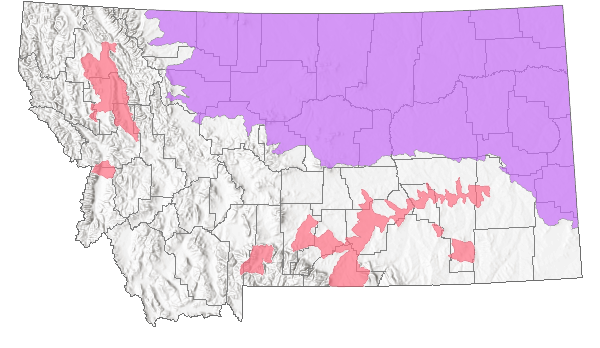
Montana Range
Range Descriptions
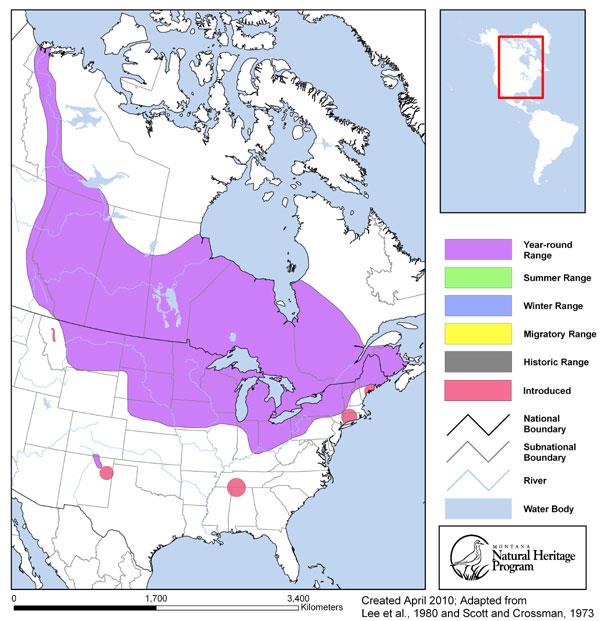
 Western Hemisphere Range
Range Comments
Native range includes the Missouri, Platte and Mississippi River drainages, from Canada, Montana and North Dakota south Dakota and northern Iowa; Mississippi River not all the way downstream to the mouth of Missouri River upstream to Illinois and Michigan. In Montana, this species is found east of the continental divide in streams of the Northern Prairies and Northwestern Great Plains Ecoregions. It has been introduced upstream in the Yellowstone River basin and the west side of the divide.
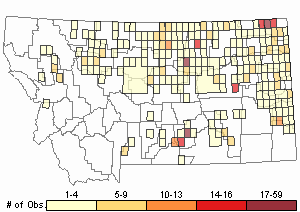
Observations in Montana Natural Heritage Program Database
Number of Observations: 788
(Click on the following maps and charts to see full sized version)
Map Help and Descriptions
Relative Density
Recency
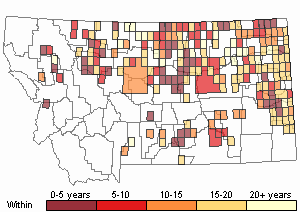

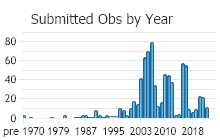
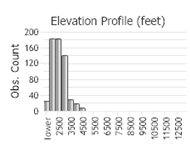 (Observations spanning multiple months or years are excluded from time charts)
Habitat
Brook sticklebacks are associated with dense vegetation in slow, clear streams and shallow lakes.
Food Habits
This species feeds on almost any aquatic invertebrate that is available. Scuds, water fleas, midges, and very small fishes have been found in their stomachs.
Reproductive Characteristics
Brook sticklebacks spawn May through June. The male builds a nest from vegetation and lures one or more females in to deposit eggs. Incubation is for 8 days at 60 degrees F.
Management
The management of this and other native and non-native fish species and their habitats is outlined in Montana Fish, Wildlife and Parks'
2023-2026 Statewide Fisheries Management PlanStewardship Responsibility
References
- Literature Cited AboveLegend:
 View Online Publication
- Lee, D.S., C.R. Gilbert, C.H. Hocutt, R.E. Jenkins, D. E. McAllister, J. R. Stauffer, Jr. 1980. Atlas of North American freshwater fishes. North Carolina State Musuem of Natural History. 867 p.
- Scott, W.B. and E.J. Crossman. 1973. Rainbow trout, Kamloops trout, Steelhead trout Salmo gairdneri Richardson. pp. 184-191. In: Freshwater fishes of Canada. Ottawa, Canada: Fisheries Research Board of Canada, Bulletin 184. 966 p.
- Additional ReferencesLegend: View Online Publication
Do you know of a citation we're missing? Barfoot, C.A. 1993. Longitudinal distribution of fishes and habitat in Little Beaver Creek, Montana. M.Sc. Thesis. Bozeman, MT: Montana State University. 66 p.
- Barfoot, C.A. and R.G. White. 1999. Fish assemblages and habitat relationships in a small northern Great Plains stream. The Prairie Naturalist 31(2):87-107.
- Burford, D.D. 2005. An assessment of culverts of fish passage barriers in a Montana drainage using a multi-tiered approach. M.Sc. Thesis. Bozeman, MT: Montana State University. 50 p.
- Duncan, M.B. 2019. Distributions, abundances, and movements of small, nongame fishes in a large Great Plains river network. Ph.D. Dissertation. Bozeman, MT: Montana State University. 255 p.
- Hendricks, P., S. Lenard, D.M. Stagliano, and B.A. Maxell. 2013. Baseline nongame wildlife surveys on the Fort Peck Indian Reservation. Report to the Assiniboine and Sioux Tribes of the Fort Peck Indian Reservation. Montana Natural Heritage Program, Helena, MT. 83 p.
- Joslin, Gayle, and Heidi B. Youmans. 1999. Effects of recreation on Rocky Mountain wildlife: a review for Montana. [Montana]: Montana Chapter of the Wildlife Society.
- Rosenthal, L.R. 2007. Evaluation of distribution and fish passage in relation to road culverts in two eastern Montana prairie streams. M.Sc. Thesis. Bozeman, MT: Montana State University. 78 p.
- Stash, S.W. 2001. Distribution, relative abundance, and habitat associations of Milk River fishes related to irrigation diversion dams. M.Sc. Thesis. Bozeman, MT: Montana State University. 82 p.
- Stringer, A.L. 2018. Status of Northern Pearl Dace and chrosomid dace in prairie streams of Montana. M.Sc. Thesis. Bozeman, MT: Montana State University. 150 p.
- Wuellner, M.R. 2007. Influence of reach and watershed characteristics on fish distributions in small streams of eastern Montana. M.Sc. Thesis. Bozeman, MT: Montana State University. 80 p.
- Young, B.A., T.L. Welker, M.L. Wildhaber, C.R. Berry, and D. Scarnecchia (eds). 1997. Population structure and habitat use of benthic fishes along the Missouri and Lower Yellowstone Rivers. 1997 Annual report of Missouri River Benthic Fish Study PD-95-5832 to U.S. Army Corps of Engineers and U.S. Bureau of Reclamation. 207 p.
- Web Search Engines for Articles on "Brook Stickleback"
- Additional Sources of Information Related to "Fish"